Letter from the Editors #9
.jpg)
Author :

The Culture of the Word — Guardians of the Poetic Word
Dear Reader,
This issue of our magazine carries a somewhat celebratory significance. This year marks the anniversaries of two individuals whose names are closely intertwined with the present day of Georgian folklore, living oral traditions, and the preservation of our cultural memory. These are Eter Tataraidze and Amiran Arabuli, who have also faithfully shared the trials and joys of marriage for decades.
In this issue, you will find two unique interviews conducted with the celebratory couple by Roma Kalandadze. These are not merely conversations about a profession or the study of the Georgian poetic word; they are stories of two remarkable life paths, of two distinct yet inseparable worlds, beautifully, poetically, and emotionally narrated by two highlanders.
We often tend to think of folklore strictly as the past, and when speaking of it, old notebooks, dusty archives, and stories from long ago come to mind. However, listening to Amiran and Etero, one can almost feel tangibly how alive folk creativity truly is, and how the power of the word can become a pillar of support along life’s difficult journey.
In his interview, Amiran emerges as the figure of a silent guardian of the oral folk treasure, who has preserved numerous pearls within notebooks worn and faded from folklore expeditions—including fragments from meetings with Vazha-Pshavela’s daughter, Gulkan, and Ivane Tsiklauri’s masterpiece, “What Has Aged Me.”
Alongside him is Etero — distinctive in her delightful Tushetian dialect and colourful nature, who, in her own words, is thrilled like a child and uplifted in spirit by the “discovery” of a forgotten Georgian word. Etero exquisitely describes the image of her mother—a woman of extraordinary aesthetic sense—who, even during profound family tragedies, forbade her children from grieving and wearing black, so as not to sadden those around them. Indeed, Etero remains ever colourful and bright-faced, yet her memory also harbors sorrowful tales, such as the sorrowful life of her neighbour, Grandma Maka, who every spring would “air out in the sun” the knitted socks intended for the son she lost in the war.
On the Trail of Forgotten Melodies
On the path of exploring our cultural and vocal heritage, the story of the Kartlian variant of the song “Chakrulo,” as recounted by Zurab Tskrialashvili, resembles a kind of musical detective story. “Chakrulo” is universally recognised as an unparalleled example of Kakhetian bourdon polyphony, yet this article unveils a completely different story. In 1938, Giorgi Svanidze recorded a version of the song from the centenarian Tigha Tlashadze, which few people know about today: it appears that in Tigha’s youth, only about three people in Kartli remembered “Chakrulo,” performing it solo to the accompaniment of the panduri with a lengthy text. It is entirely possible that the song actually transitioned from here to Kakheti where it acquired the stroke of genius we know today. The author also shares the etymology of the song’s title and the history of its origins.
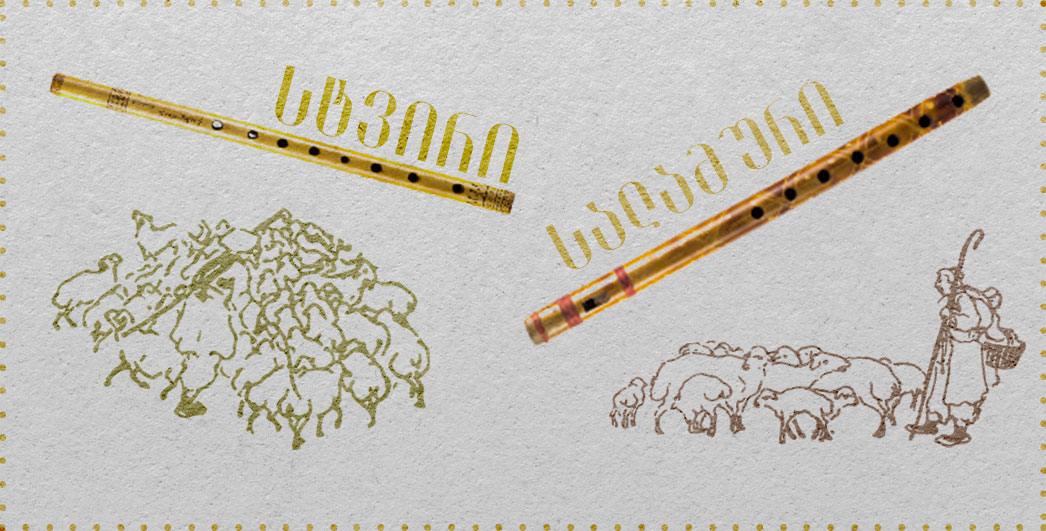
Even more dramatic is the fate of the larchemi-soinari (the Gurian soinari and Megrelian larchemi)—an ancient Georgian wind instrument. Drawing upon archives, Tevdore Gogoladze’s article revives the adventures of this instrument, which was a unique, double-sided, ascending six-pipe panflute that allowed the performer to play two-part polyphony. However, a comparison with similar instruments around the world reveals that while the foreign counterparts of the larchemi were establishing their place on the international academic stage, the Georgian instrument lost both its everyday and magical functions, turning into a mere museum exhibit.
Notated Georgian Song, the Azarpesha, and the Flavours of Abkhazian Cuisine
The practice of notating folk songs, along with its merits and flaws, has frequently been a subject of discussion and research. David Shughliashvili’s research into the history of notation has led him back to the very origins of recording Georgian voices—to the period even before the invention of the phonograph. Within this essay, the reader will discover several folk pieces notated at the beginning of the 19th century and will become acquainted with many historical episodes that, until now, were kept on the shelves of archives. Thus, you will learn, for instance, what connection Iakob Gogebashvili, the author of the monumental Deda Ena [Mother Tongue], had with Georgian song, and what role he played in its salvation.
Alongside our spiritual, intangible treasure, this issue of the magazine also dedicates space to material and gastronomic culture. The reader will be introduced to the philosophy of the azarpesha — a traditional drinking vessel that has become quite rare today. This masterpiece of metalworking was once a source of inspiration for poets and folk craftsmen alike. The azarpesha, which held a mere 50–60 millilitres, bears witness to the moderation and high culture of the Georgian supra and wine-drinking traditions. The author of the article, Luarsab Togonidze, an enthusiastic researcher of traditional Georgian culture and a collector of photographs, shares numerous fascinating images with us.
The rich cultural life of Georgia is further evidenced by its gastronomic diversity. Dalila Tsatava tells us about Abkhazian cuisine, which stands as a living example of shared Georgian-Abkhazian roots and coexistence. Along with Abkhazian flavours, the author introduces us to its aesthetic, refined traditions of serving. Many Abkhazian dishes will remind you of familiar tastes, proving that culinary memory and the strict hierarchy of hospitality, alongside regional variations, preserve a close historical and cultural unity.
Knights of Chant and the Moral Formula of the Fairy Tale
The phenomenal history of the Dumbadze family of chanters will also come to life within the pages of this magazine. This subject is explored by Ilia Tavberidze, a tireless researcher of Gurian archives, who once again spoils us with new, hitherto unknown stories. It was indeed the Dumbadzes who enabled Pilimon Koridze to transcribe over 3,000 chants into musical notation, thereby rescuing an invaluable heritage from extinction. Their chronicles resemble the plot of a true adventure film: a 12-room oda (traditional wooden house) in Shemokmedi, where chanting was taught free of charge; Sonia Dumbadze, a singer at La Scala; and the talented yet scandalous Vaso Dumbadze—Georgia’s consul to America and the prototype for Kvachi Kvachantiradze.
And finally, Elene Gogiashvili’s article is dedicated to a philosophical analysis of the Georgian magical fairy tale or “wonder tale.” This time, the author focuses on an intriguing phenomenon: the arduous journey of the Georgian fairy tale hero (be it Asphurtsela or “the youngest brother”) is a conscious choice rather than destiny. The author’s perspective underscores the pre-Christian roots of Christian morality: the hero’s free will, the refusal to become arrogant through davlat (divine fortune), humility, ascending from the underworld, and triumphing over false heroes. This is nothing other than the Christian formula: “...the last shall be first” (Matthew 19:30).
“Turn the pages” of the magazine and discover these wonderful stories, which remind us once again of who we are and where we come from.