The Hero’s Journey in the Georgian Wonder Tale
Author :

The Georgian wonder tale preserves traces of numerous historical periods and genre transformations. Its hero combines the characteristics of both the mythic hero and the protagonist of chivalric romance. The hero's conduct frequently reflects a model of moral behaviour closely aligned with the principles of Christian ethics. Although the wonder tale is neither myth, nor hagiography, nor chivalric romance, its hero shares important characteristics with the mythic hero, the saint, and the knight alike.[1] When comparing the heroes of myth and epic with those of the wonder tale, the first aspect to consider is the course of their lives.

Hunting scene on a bronze belt from the Samtavro burial ground, 9th–8th c. BC. Held at the Georgian National Museum
The Life Pattern of the Mythic-Epic Hero
A number of scholars have attempted to describe the life pattern of the hero in mythic and epic traditions. One of the earliest was Johann Georg von Hahn.
In 1876, Johann Georg von Hahn (1811–1869) outlined a life pattern for the mythic-epic hero. As Jan de Vries notes, Hahn divided the hero's life into three stages: birth, youth, and return or death. He identified thirteen motifs that occur either wholly or in part in Roman, Persian, Indian, and Germanic epic traditions.[2]
In 1936, Lord Raglan sought to establish the archetypal hero pattern (Hero pattern), distinguishing twenty-two recurrent motifs.[3]
In 1954, Jan de Vries proposed a similar model for the life of the fairy-tale hero, and in 1961, in his monograph Heldenlied und Heldensage (Heroic Song and Heroic Legend), he presented a life pattern of the epic and mythic hero based on Indo-European material.[4]
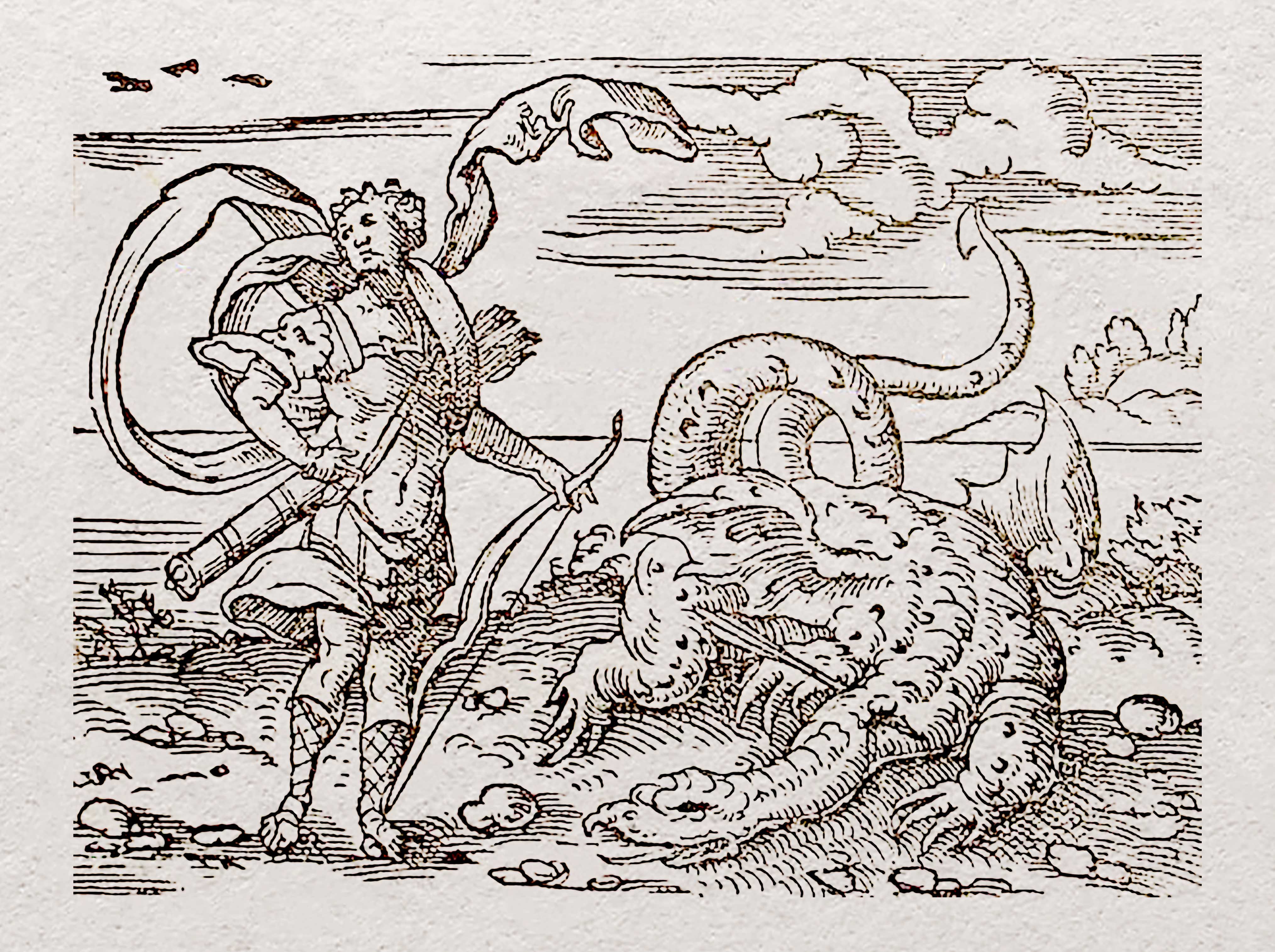
Apollo's battle with the serpent, on a 1581 engraving from Ovid's Metamorphoses
According to de Vries, this pattern applies, in general terms, to myth, heroic epic, and the wonder tale alike. He distinguishes ten episodes: 1) the hero's conception; 2) the hero's birth; 3) the hero is threatened in infancy; 4) the hero displays extraordinary strength already in childhood; 5) the hero is invincible; 6) one of the hero's most characteristic exploits is combat with a monster; 7) the hero wins a maiden after overcoming an ordeal; 8) the hero descends into the underworld; 9) if exiled in childhood, the hero later returns, defeats his adversary, and regains what rightfully belongs to him; 10) the hero's death.
These patterns are reflected, to a certain extent, in the Georgian wonder tale as well.
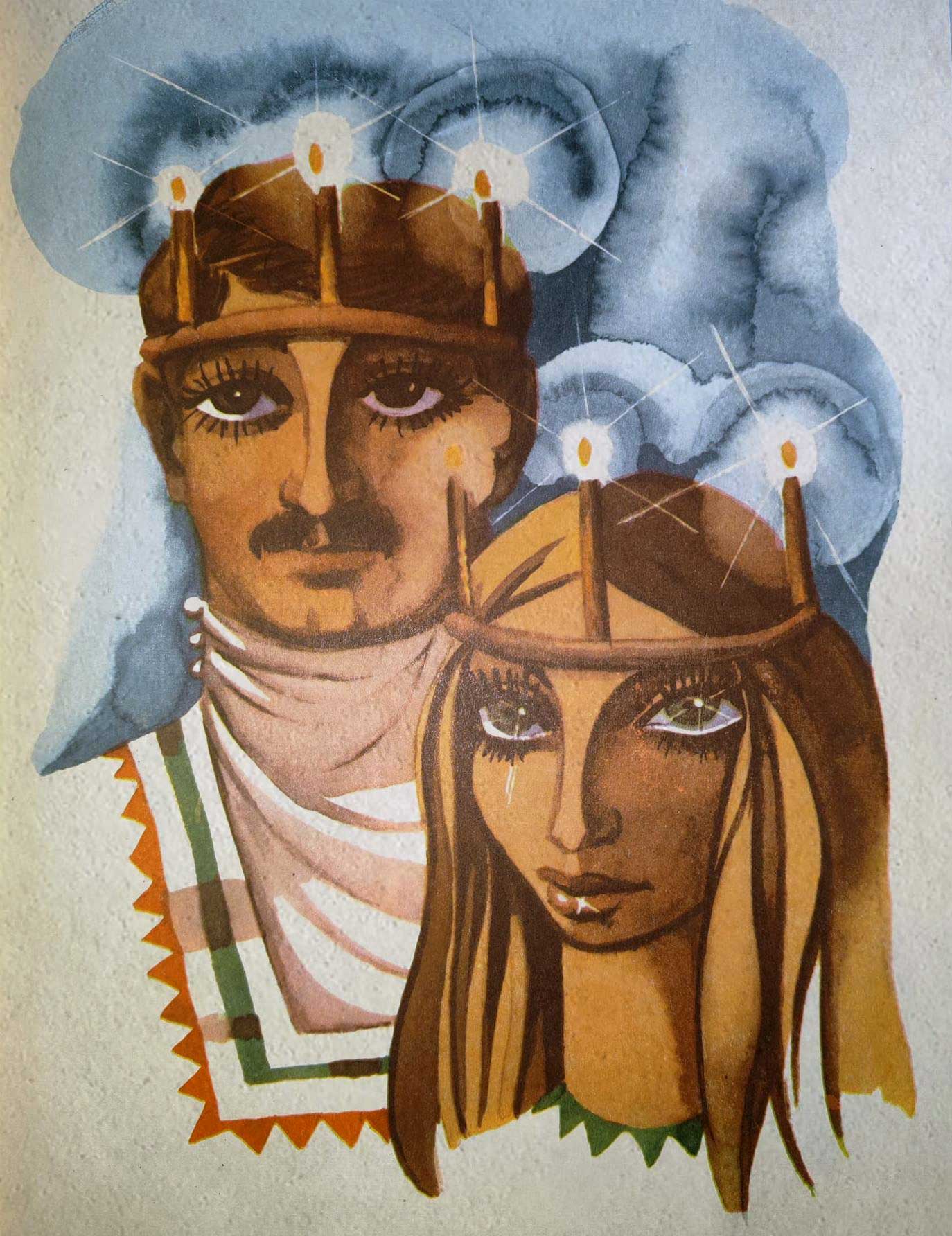
The Reed Maiden. Georgian folk tale. Tbilisi, Nakaduli, 1982. Illustrated by O. Chkhartishvili.
The Hero's Extraordinary Power and „Davlatianoba“
The most significant moments in the hero's life – miraculous birth, combat with a monster, the rescue of a maiden – are, in general, characteristic motifs of heroic narratives. These moments are fundamental both to Georgian wonder tales and to myth and epic.
Some heroes are born miraculously – for example, Asp'urtsela, Ivane Tsiskrisa, Black Teimuraz and his brothers, Adikhanjala, and others. From birth they possess extraordinary strength, thanks to which they achieve their goal. This magical power closely resembles the divine power of mythic heroes, called in the mountainous regions of eastern Georgia „davlatianoba“ (good fortune, luckiness).
Divine power is regarded precisely as a sign of good fortune, that is, davlatianoba. An example of divine power is Amirani, who possessed the speed of a falling tree, granted to him by Christ God at baptism, the swiftness of an avalanche, the strength of twelve yoked oxen and buffaloes, the knee of a wolf, eyes the size of a sieve, and a golden tooth.
The hero of the wonder tale is likewise „davlatiani“ – both when he takes on the function of donor or helper, and when he acquires this quality only later.
Like the davlatiani mythic hero, the wonder-tale hero too may lose his davlati – for instance, while bathing. Torghva loses his chain while bathing, and the youngest daughter of the sun loses her garment, without which she can no longer turn into a bird.[5] As for the bald gardener, his golden tuft is discovered while he is washing.[6]
Davlati will betray the tale's hero just as it does the mythic hero, though, unlike him, the tale's hero survives all the same. The davlatiani mythic hero ends his life in „gabudaqeba“[7] and fitting punishment, whereas the tale's hero is never led into gabudaqeba by davlati. In this respect we may see in the tale's hero the ideal of the devout Christian, whom pride cannot touch.
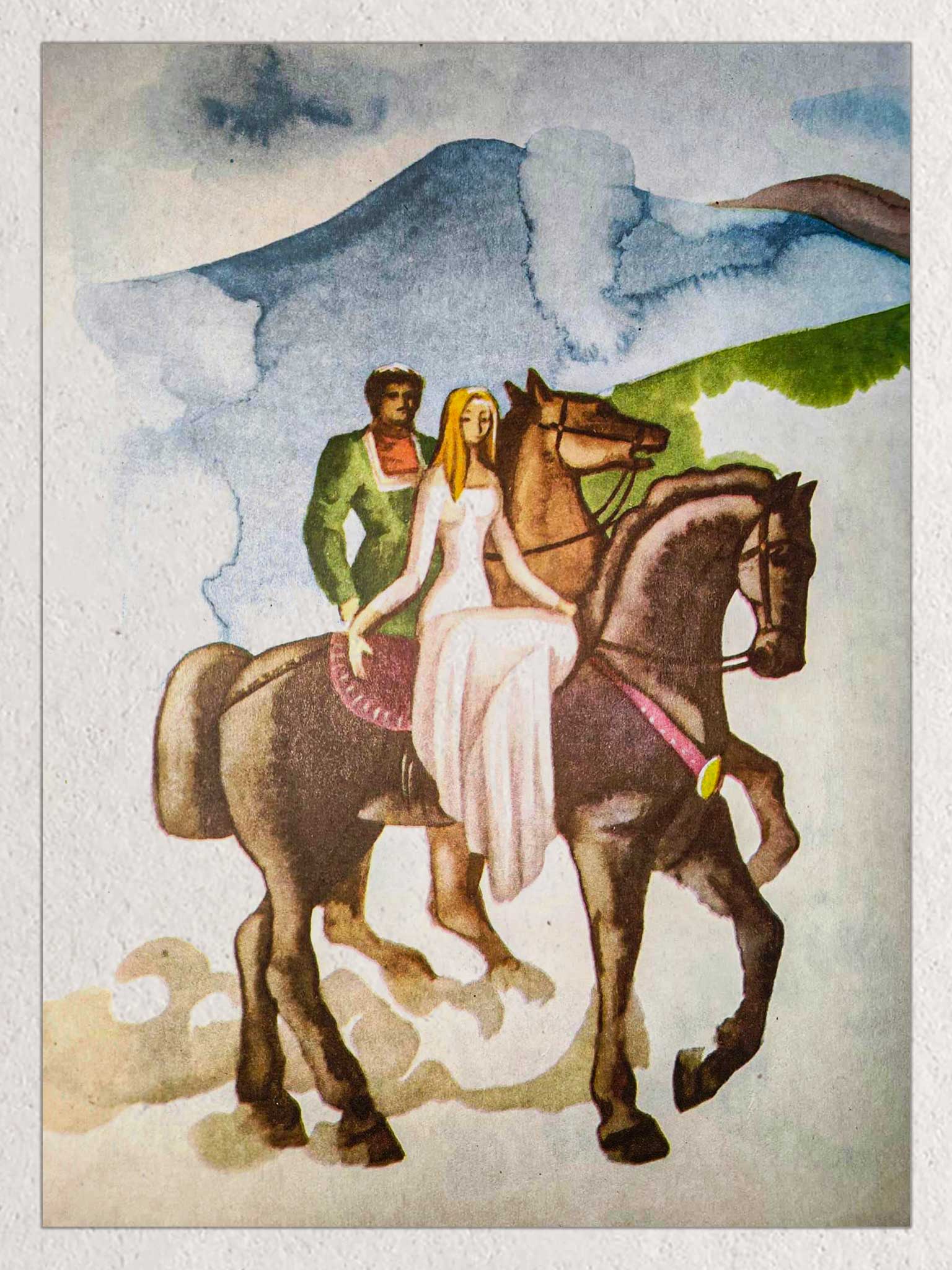
The Reed Maiden. Georgian folk tale. Tbilisi, Nakaduli, 1982. Illustrated by O. Chkhartishvili.
The Crossroads and the Hero's Choice
In myth, a person's life is often determined by fate, which he cannot resist, or, if he does, only in vain. In myth, a person does not possess the freedom that the tale's hero has in relation to his own fate. In this regard the tale's hero is closer to the martyr and the knight.
The tale's hero knowingly sets out on a road full of danger. This quality is manifested in his character in many ways, among which the capacity for choice is especially important.
Choice may occur in myth as well, but not in the form it takes in the wonder tale. For example, the myth of the „Apple of Discord“ concerns precisely the theme of choice. The choice of the Trojan prince, however, differs sharply in its outcome from the choice of the tale's hero. For Paris his choice proved fatal, whereas the heroes of the tale, through their choice, attain eternal happiness.
The tale's hero chooses the hardest road, whose final outcome is the defeat of evil and the overcoming of death. For this reason the tale's hero, in this instance, stands closer to the Christian martyr than to the mythic hero.
In the Christian tradition, the road chosen by the martyr is fully conscious, and to walk it with patience is bound up with eternal happiness. For Christ, martyrdom means not only the recognition of truth and faith, but also the sacrifice of life itself. In the early Christian era the shortest road toward sainthood was precisely martyrdom, and it became a symbol of virtue.
The hero of the wonder tale, often the youngest brother, chooses the hard road from the very start, and, as a rule, this choice is made at a crossroads.
The crossroads is an ancient mythological symbol, and, as a cosmogonic sign, represents the centre of a world divided into four directions. It is the place where a person meets his own fate. It is precisely in the tale hero's choice that the freedom of his will is expressed, which is the most important condition for the manifestation of his personality.
The inscription at the crossroads is a well-known motif in the tales of the peoples of the world, and it is often precisely here that the story of the three brothers begins.
Whether they walked long or short, they came out onto a crossroads. There lay a great stone, and there they rested. On that stone was written: whoever goes by this road shall return again; whoever goes by this road shall either return or not; and whoever goes by this road shall never return at all. One of the roads, too, was the road to their own home. This stone lay right at the meeting-point of all four roads, and each inscription faced its own direction.
— „What shall we do once we reach home,“ they said, „the enemy will surely have destroyed everything there,“ and they chose to go their separate ways. The eldest brother chose the road on which it was written: let him go, and return again. The middle brother chose the second: let him either return, or not. The youngest, though, chose the third road – let him go, and never come back. The brothers urged him greatly: „Choose our road, do not go that way,“ but he would not listen.[8]
This motif is very frequent both in Georgian tales and in European and Near- and Central-Asian tales.
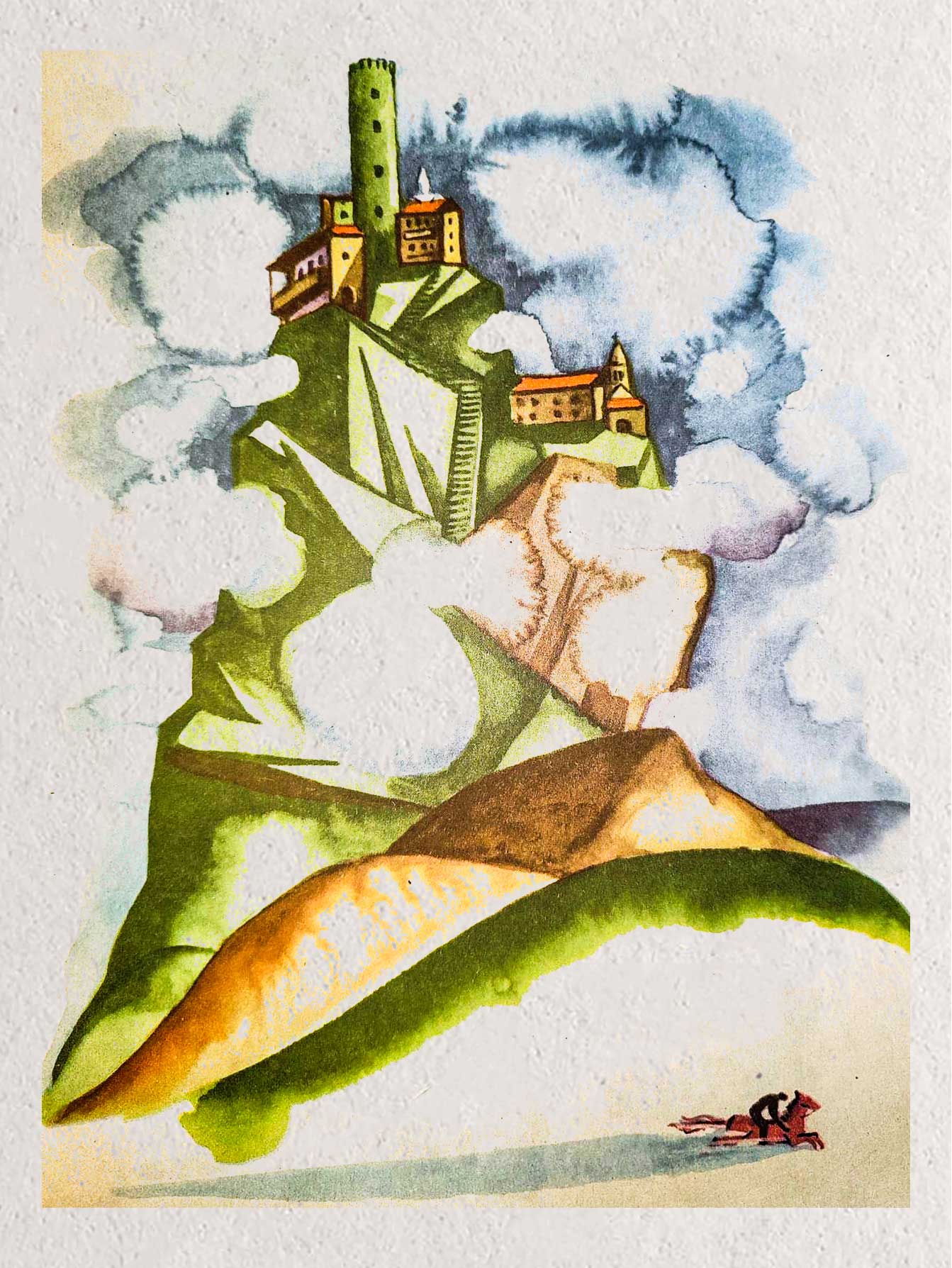
The Reed Maiden. Georgian folk tale. Tbilisi, Nakaduli, 1982. Illustrated by O. Chkhartishvili.
Descent into the Underworld and the Hero's Return
The crossroads episode is usually followed by the brothers leaving their rings beneath a stone, and then by the betrayal of the elder brothers, as a result of which the youngest brother ends up in the underworld. The descent into the underworld and the return from it may be symbolically linked to the idea of eternal life after a martyr's death.
The youngest brother's choice, which at the beginning of the tale seems almost mechanical, is at bottom far deeper. He chooses the hardest road, because this is the road that leads toward the goal. The youngest brother is the chosen one, and he himself makes the choice. This is why he returns home victorious, and even arrives at his brothers' „false wedding.“[9] In the tale this is not merely a return home, but also the exposure and punishment of evil.
As an example we offer the Kartlian variant of the tale of the three brothers, whose ending may be said to be the quintessence of the wonder tale:
— „Father, I must give a toast,“ he said.
He took the cup and told the whole story from beginning to end – how his brothers betrayed him, how he fell into the underworld, how the paskunji bird carried him up, how he slew the dragons – he told everything. As soon as the king heard this tale, he said to his eldest and middle sons: „Since you have proven to be your brother's betrayers, I no longer wish to see you in my kingdom,“ and he drove them both out entirely. Their promised brides he married off to other young men. He held a fine wedding. And the kingship, and everything else, he left to his youngest son.[10]
The youngest brother disowns his brothers before their father in just the same way that they disowned him when they cast him into the underworld and appropriated all that he had won.
Zurab Kiknadze, in his article „The Eschatology of the Wonder Tale,“ uses as an epigraph the words of the Saviour from the Gospel of John, noting that these words could also be spoken in the name of the tale's hero: „I came forth from the Father, and am come into the world; again, I leave the world, and go to the Father.“[11]
Many tales end with escape from pursuit. The hero returns home, and, if he has won a bride, marries her. Yet this is not always so. At times the tale prepares a new ordeal for the hero: his enemy appears again, his winnings are stolen from him, and he himself is killed. In a word, the „knot-tying malfeasance“ is repeated once more, sometimes in the same form as at the beginning, sometimes in another, a form new to this particular tale.[12]
Laz Tales. 1970. Illustrated by G. Lomidze
The False Hero and the Recognition of the True Hero
Before the hero returns home, the brothers seize what he has won, and throw him into a well. Here a new episode begins.
After falling into the well, the youngest brother finds himself in the underworld. He begins his search anew, obtains a magical means or helper, and once again rises to the earth. When the hero comes home, he is not recognised. The false hero appropriates the hero's rights and name. As a rule, the king, or the king's daughter, sets the hero and the false hero a difficult task, through which the true hero is revealed. He is recognised by a sign, a mark, or some object given to him. The false hero is exposed and punished – „for nothing is hidden that shall not be revealed, neither anything secret that shall not be made known and come to light.“[13] The youngest brother's return may be compared to a highest court of judgement. The youngest brother duly punishes his elder brothers, who abandoned him and cast him into the underworld. He exposes them before the king-father.
The hero marries. Here the tale ends, and we may again recall the words of Scripture: „And these shall go away into everlasting punishment, but the righteous into life eternal.“[14]
In the tale „Devi's Sanakhevro“ (Half of the Devi), the king, after the battle, binds the hand of his son-in-law, thinking him a stranger:
At that moment this son-in-law of his drew out his bloodied sword and began wiping and wiping it, as though he were merely cleaning the blade. In the course of this cleaning he cut his hand. The king took his own handkerchief and bound up the hand with it… …the king then summoned everyone he had in his kingdom, and washed every single one of their hands with his own hand. He washed everyone's hand, and now he came to that bald gardener and said: „Hold out your hand, I must wash it.“ The gardener said to him: „How am I worthy that you should wash my hand?“ But the king would not relent. He held out his left hand, but would not show his right. The king made him hold out his right hand too, looked at it, and recognised his own handkerchief upon it. At once he raised him up, first kissed him, then led him away and seated him upon his own throne: „You were never fit to be a gardener.“ Then this son-in-law said to the king: „Well then – you who despised me, and favoured your other sons-in-law, your nazirs and viziers – am I the better man, or are they?“[15]
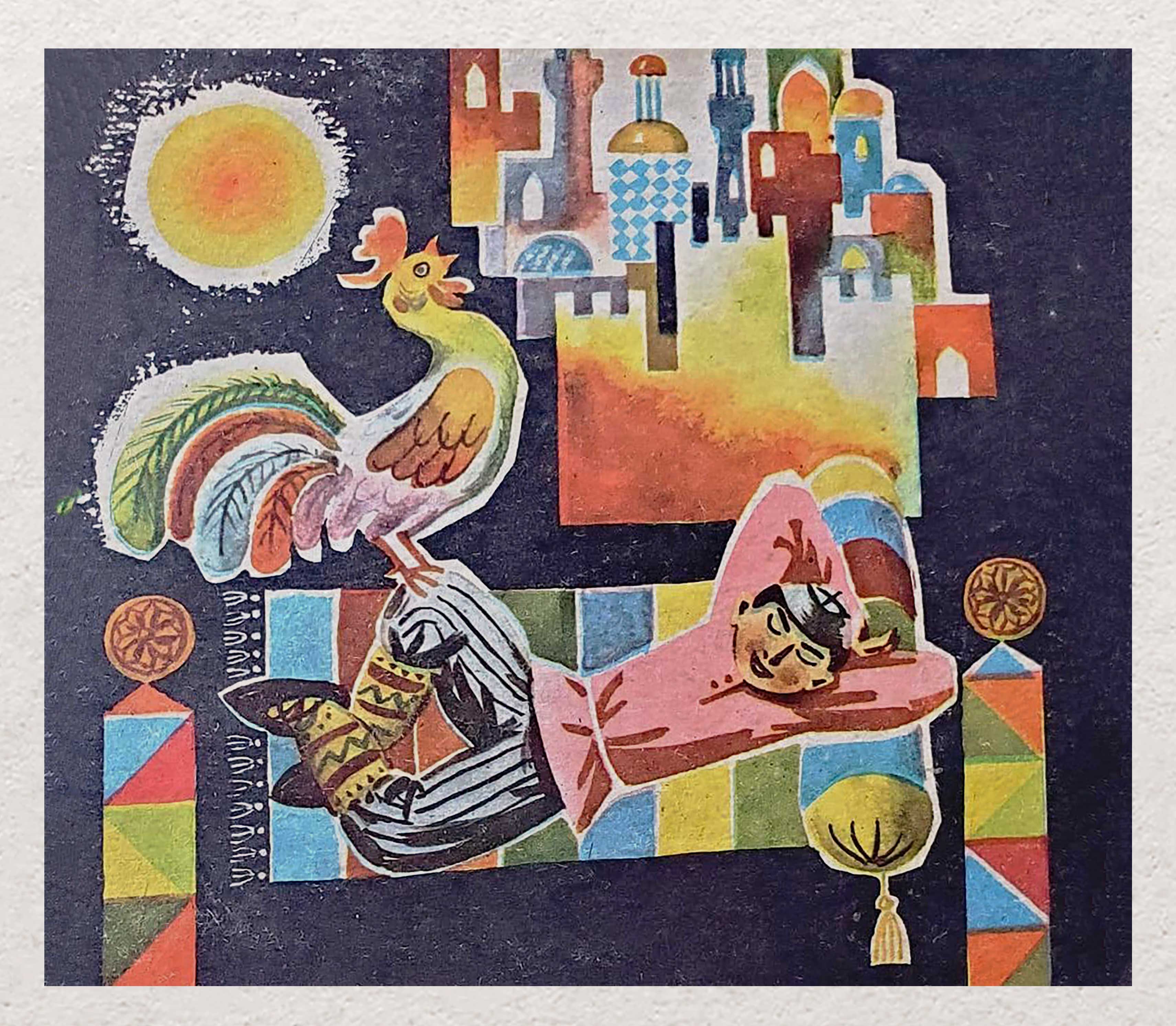
Laz Tales. 1970. Illustrated by G. Lomidze
In the tale „Arvitsia“ (I Don't Know) the same combat motif appears as in „Devi's Sanakhevro,“ but here the hero deliberately cuts his own arm, so that the king will bind it up: „Then he forcibly gashed his arm against the sword; at that his father-in-law rushed to him, drew out a baghdadi, and bound up his arm.“[16]
„The Tale of the Heroes Khristagani and Beltagani“: „As he sheathed his sword, Kochora cut the finger of his left hand. The king untied the ribbon of his collar, and with it bound up the finger.“[17]
„The Gooseherd“:
He outran the padishah and his army, defeated the enemy, and turned back. In the battle he had cut his finger. The padishah bound up his hand with a handkerchief embroidered by his youngest daughter… …when the padishah's youngest daughter saw her husband's bandaged finger, she recognised her own embroidered handkerchief. Her husband, however, revealed nothing. Then the daughter sent word to her father: your handkerchief is with my husband, the gooseherd. The padishah laughed: „The man whose finger I bound is no horseman who rides a mule, like your husband!“ The gooseherd laughed at the padishah's words.[18]
„The Wolf-Man“
Then, when the war was over, the bald gardener turned back, and as he was sheathing his sword, he cut his hand a little on his own blade. As soon as the king saw this, he rushed forward at once, drew out his pocket baghdadi, and bound up the wounded hand. When the king's youngest daughter reminds him of her husband, the king answers: „What business had your husband there? I bound the hand of an angel sent to me by God, and you would credit that to your husband?“[19]
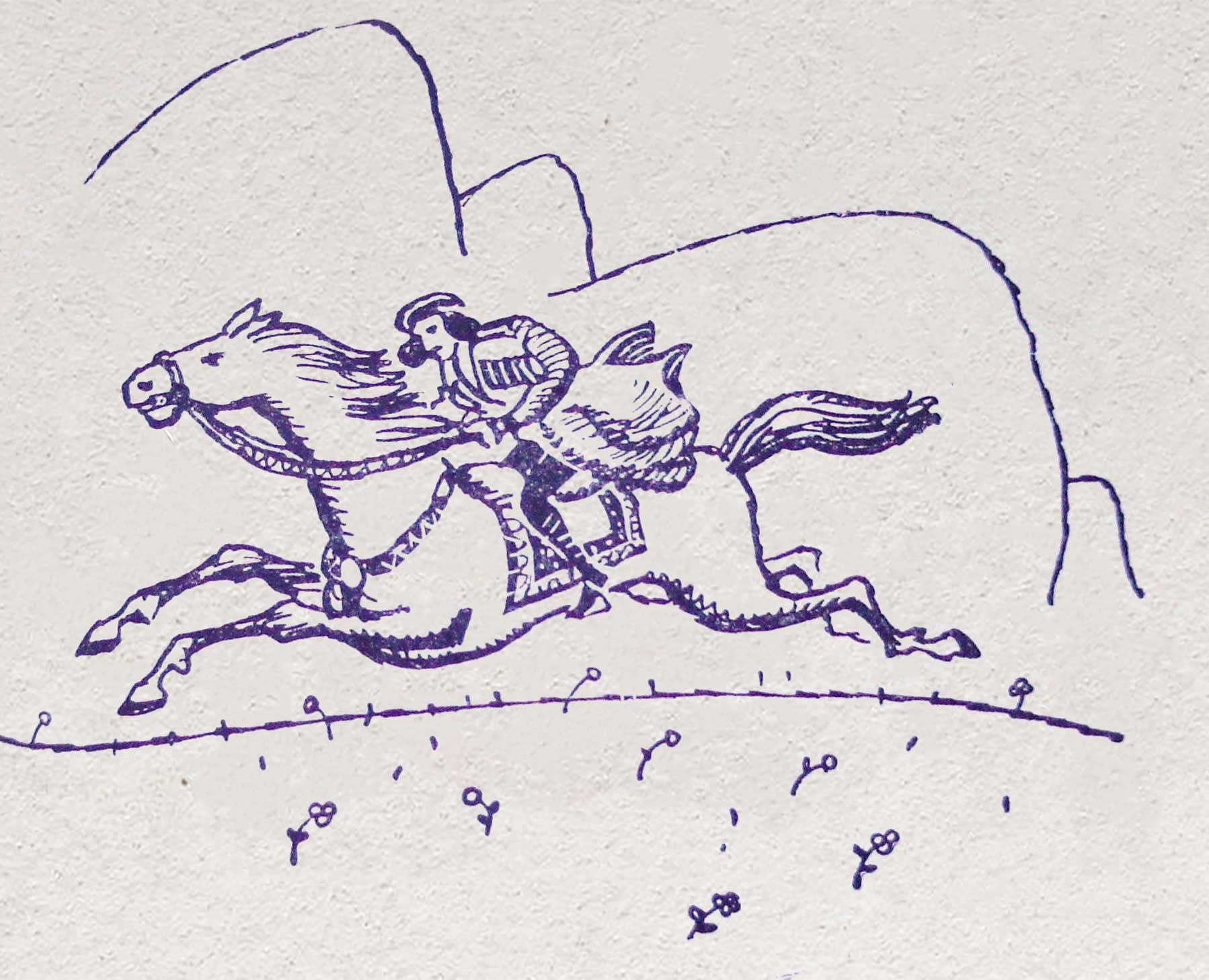
Laz Tales. 1970. Illustrated by G. Lomidze
The Tale's Hero and Moral Victory
As these examples show, the hero who displays knightly humility is, at the outset of the tale, „last,“ and at the end – „first.“ In this respect the logic of the tale coincides with Christian moral norms.
The shared traits of the heroes of myth, epic, and tale – semi-divinity, chosenness, struggle against evil forces, and others – are universal concepts, found not only in the folklore of various peoples but in religious symbolism as well. It is clear, of course, that in every tale one will sense the influence of the religion of the community within which it existed.
The heroes of Georgian tales bear mythic-epic features, in which a pre-Christian religion may be discerned. They are of mythic origin, they possess the traits characteristic of an epic hero, while their conduct is suffused with Christian ethics.
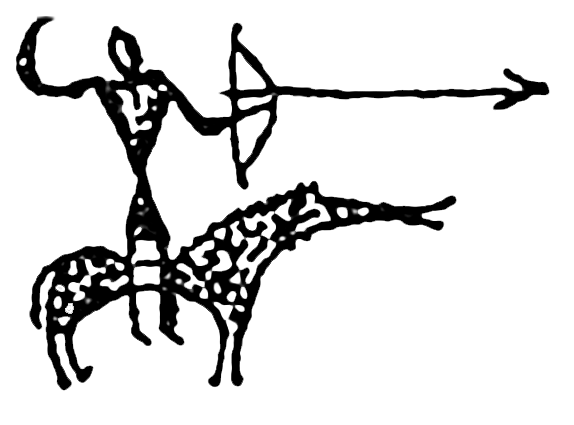
Detail from a bronze belt.
The opposition of good and evil, and the conclusion of this struggle in the victory of good, is the quintessence of the folk tale. This is, in general, the basic principle of the wonder tale, which determines its structure.
The hero's path – the choice at the crossroads, the passage through ordeal, the fall into the underworld, and finally the revelation of truth – leads precisely toward this moral victory. In essence, the central idea of the tale is that the hero triumphs not through physical strength alone, but through moral choice as well.
[1] Mythic hero – a semi-divine figure acting within the mythological world; epic hero – the central figure of a historical-heroic narrative; tale hero – the character of an invented, fantastical story, whose life is built upon moral choice and the overcoming of ordeal.
[2] Vries, Jan de. 1961. Heldenlied und Heldensage. Bern/München: Francke, p. 281.
[3] Raglan, Lord. 1965. The Hero of Tradition. In The Study of Folklore, edited by Alan Dundes, 142–157. Berkeley: University of California Press. pp. 142-157.
[4] Vries, Jan de. 1961. Heldenlied und Heldensage. Bern/München: Francke.
[5] Umikashvili, Petre. 1964. Folk Literature, vol. III: „The Sun's Bridegroom.“ pp. 176–183. Tbilisi: Literatura da Khelovneba.
[6] Ibid: „Devi's Sanakhevro.“ pp. 143–153. Also ibid: „The Childless Hunter“ (pp. 258–263). Chikovani, Mikheil (ed.). 1960. Folk Wisdom, in Five Volumes, vol. I: „The Blind Shepherd Devi and the Weaver's Son.“ pp. 143–150. Tbilisi: Nakaduli.
[7] Gabudaqeba (Mtiuletian dialect) – the attempt of a man who has grown rich to set himself apart from his community. The community would isolate such a man completely, cutting him off – one of the means by which it fought against the privileges thereby created within it. The term „gabudaqeba“ was introduced into Georgian scholarly usage by Zurab Kiknadze.
[8] Chikovani, Mikheil (ed.). 1956. Folk Literature, vol. V. „The Miracle-Working Shirt.“ p. 62. Tbilisi: Publishing House of the Academy of Sciences of the Georgian SSR.
[9] Kiknadze, Zurab. 1991. The Eschatology of the Wonder Tale, Skola da Tskhovreba, No. 1, pp. 13–18.
[10] Ghlonti, Alexandre. 1948. Kartlian Tales and Legends: „The Youngest Son.“ p. 248. Tbilisi: Sabchota Mtserali.
[11] Kiknadze 1991, p. 13.
[12] Propp, Vladimir. 1984. Morphology of the Folktale. Translated, with an introduction, by Mariam Karbelashvili. Tbilisi: Metsniereba, p. 99.
[13] Luke 8:17
[14] Matthew 25:46
[15] Umikashvili 1964, p. 243.
[16] Chikovani 1956, p. 9.
[17] Dzidziguri, Shota (ed.). 1991. Georgian Folk Literature: Megrelian Texts, vol. II. Tbilisi: Tbilisi State University Press, p. 83.
[18] Tandilava, Zurab (comp.). 1970. Laz Tales. Tbilisi: Nakaduli, p. 105.
[19] Chikovani 1956, pp. 267–268.


.jpg)