Azarpesha
Author :

Introduction
Recent scientific discoveries have confirmed that the inhabitants of the territory of present-day Georgia have practised agriculture since prehistoric times. Archaeological research has demonstrated that the South Caucasus, including the territory of modern Georgia, was one of the earliest centres of the cultivation of cereals, including wheat, as well as the vine. Furthermore, modern technological analysis of fossilised grape pips recovered from clay vessels has shown that, as early as the sixth millennium BC, a well-developed tradition of winemaking already existed in this region.[1] These findings point to an uninterrupted history of viticulture and winemaking extending over several millennia.
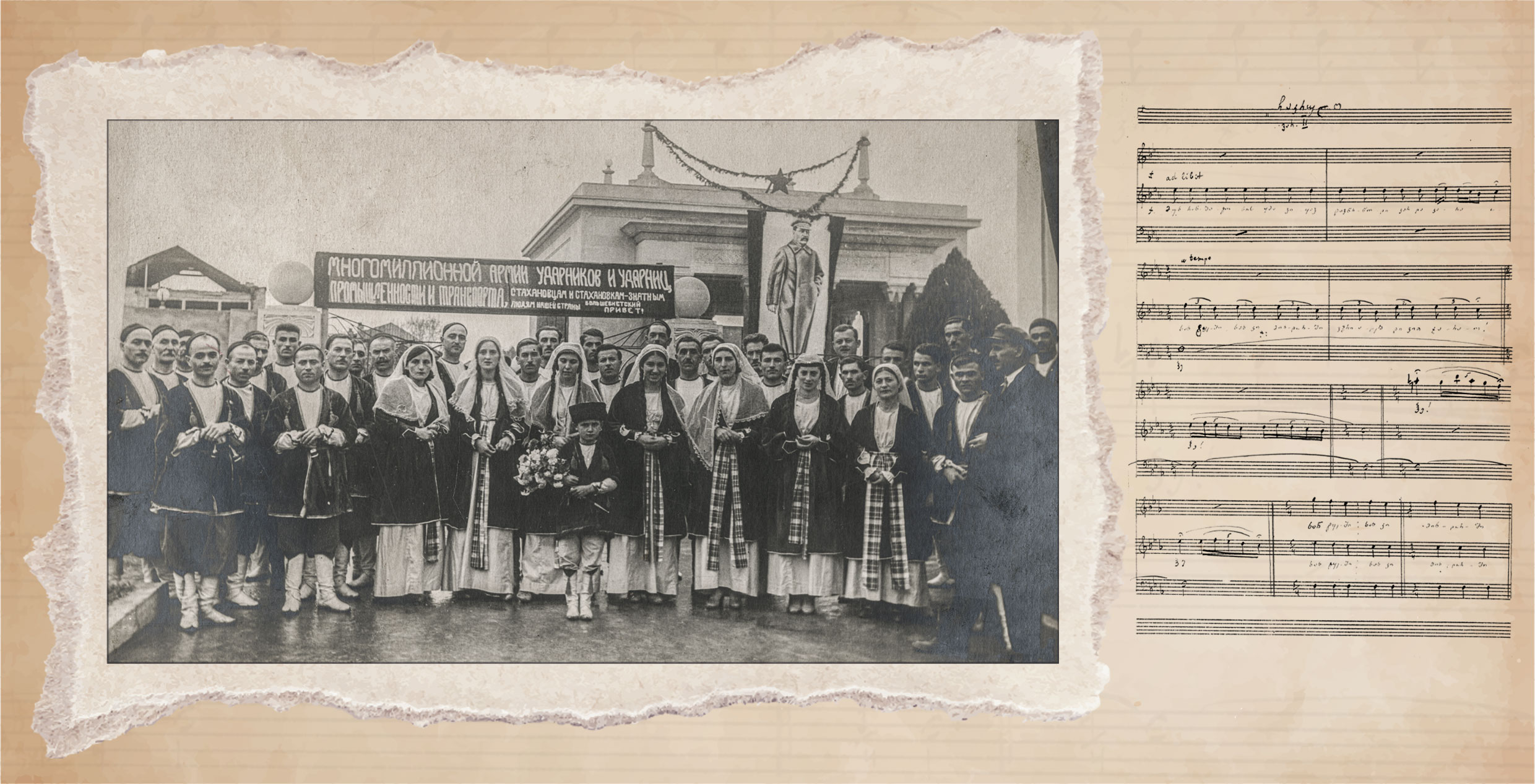
The traditions of agriculture, craftsmanship, hospitality, cuisine, folklore, polyphonic singing and chant, as well as the customs of the supra and festive celebration, testify to Georgia’s rich cultural heritage. Viticulture and winemaking have played a fundamental role in the formation of the Georgian nation, shaping its way of life and cultural traditions. The remarkable abundance and diversity of wine vessels and drinking cups reflect a centuries-old heritage, many elements of which have survived to the present day.
This article examines one distinctive Georgian wine-drinking vessel — the azarpesha — and the traditions associated with it.
Azarpesha: Its Nature and Historical Development
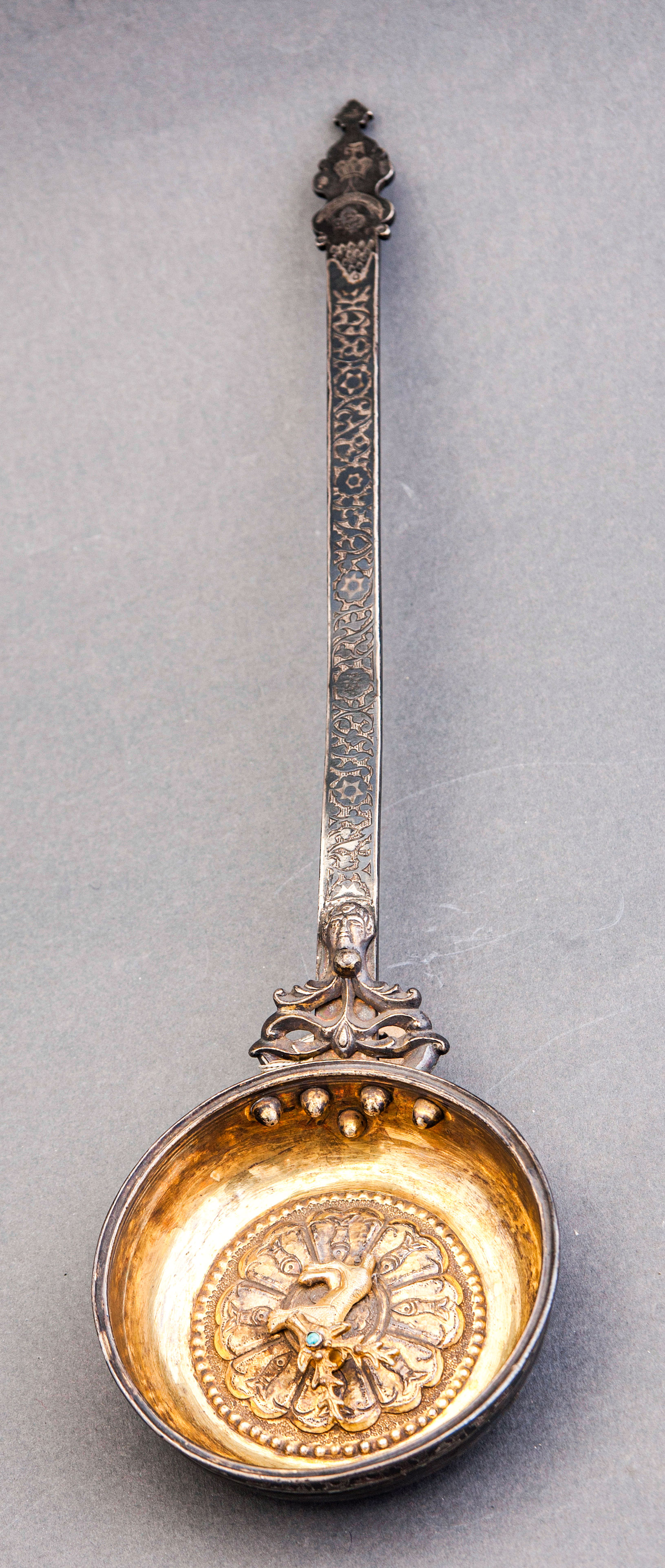
The azarpesha is a Georgian wine-drinking vessel — a shallow bowl with a long handle. It was made primarily of silver, was widespread throughout almost every region of Georgia, and was most commonly associated with the nobility and other affluent social groups. Most surviving examples date from the nineteenth century, although museums and collections also preserve azarpeshas from the seventeenth and eighteenth centuries.[2]
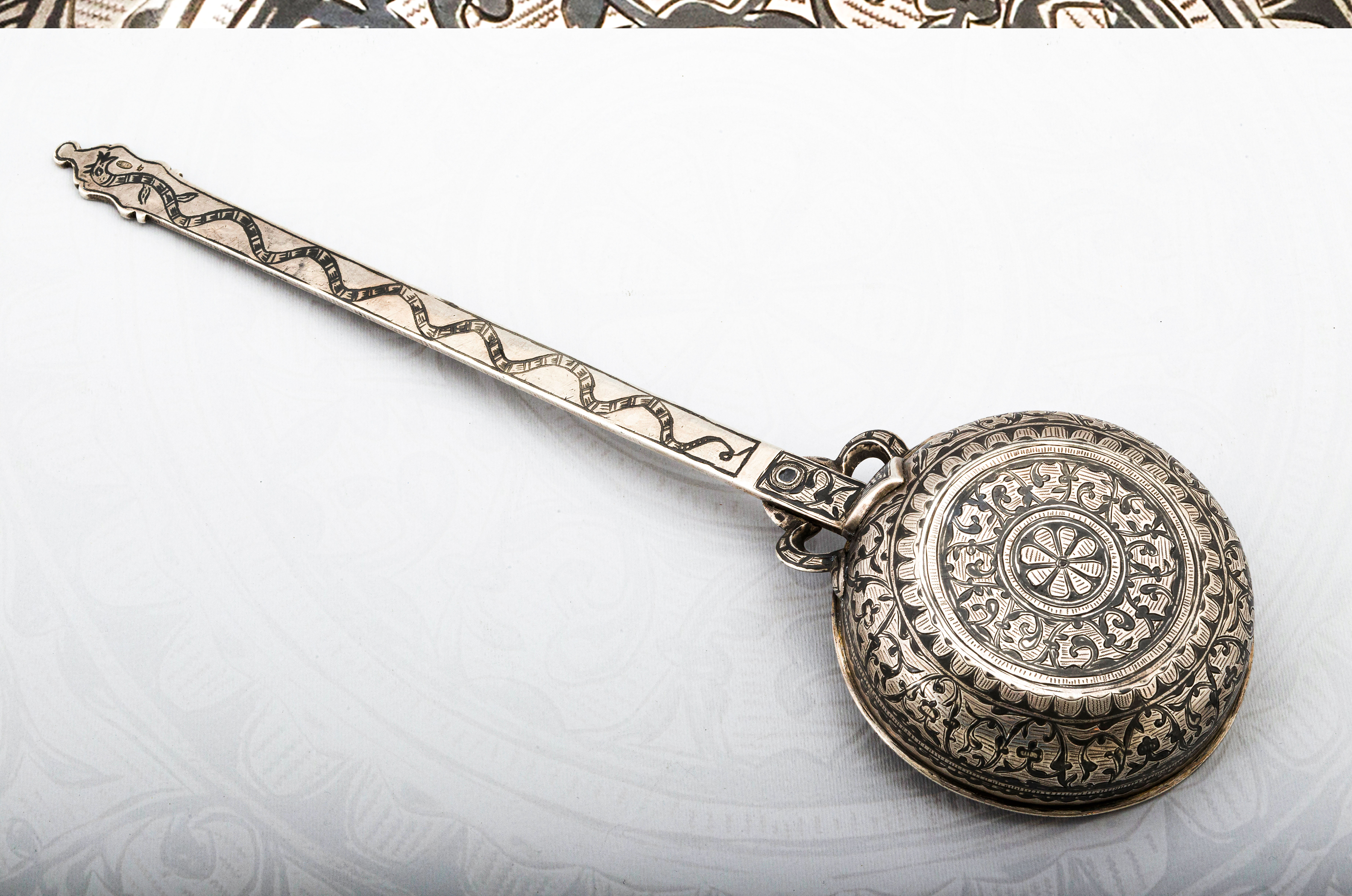
Including its handle, an azarpesha typically measures between 20 and 35 centimetres in length, while the diameter of its bowl generally ranges from 8 to 15 centimetres. The handle is attached to the bowl with rivets. In most examples, a third element reinforces the junction between the handle and the bowl. Besides its primary function, this component also serves a decorative purpose.
Manufacturing Techniques and Diversity
The azarpesha, like many other silver drinking vessels, exists in both plain and decorated forms. To ornament them, goldsmiths employed a wide range of techniques, including engraving, embossing, niello, filigree, and gilding, through which they produced both simple and richly decorated examples of the vessel.[3]
The overwhelming majority of surviving azarpeshas are made of silver. There are also examples decorated with small gold elements. No fully gold azarpesha has yet been identified; however, archival documents and dowry registers confirm their existence (Georgian National Museum, goldsmithing collections; archival and dowry register data).[4]
A small number of azarpeshas made of bullion[5] and brass have also survived (Ushguli Museum, as well as specimens discovered in a jar during the reconstruction of Gudiashvili Square).
Decoration and Symbolism
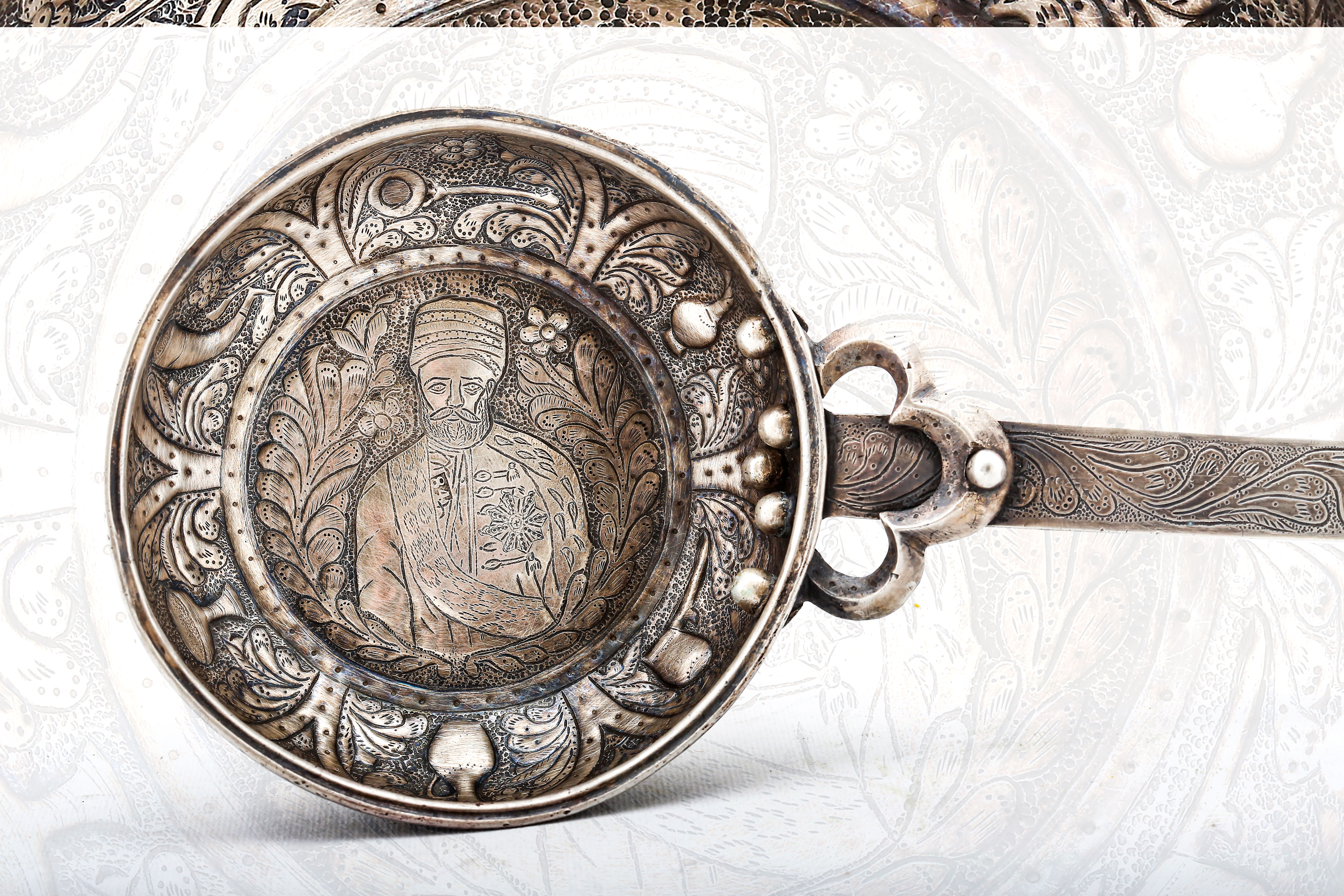
As with other wine vessels, decorated azarpeshas often feature, in addition to a variety of ornamental motifs, depictions of figures venerated by the Georgian people. Engraved portrait representations of Queen Tamar, Shota Rustaveli, King Erekle II, and Murzakan Dadeshkeliani are preserved in numerous examples (Georgian National Museum, goldsmithing collections).
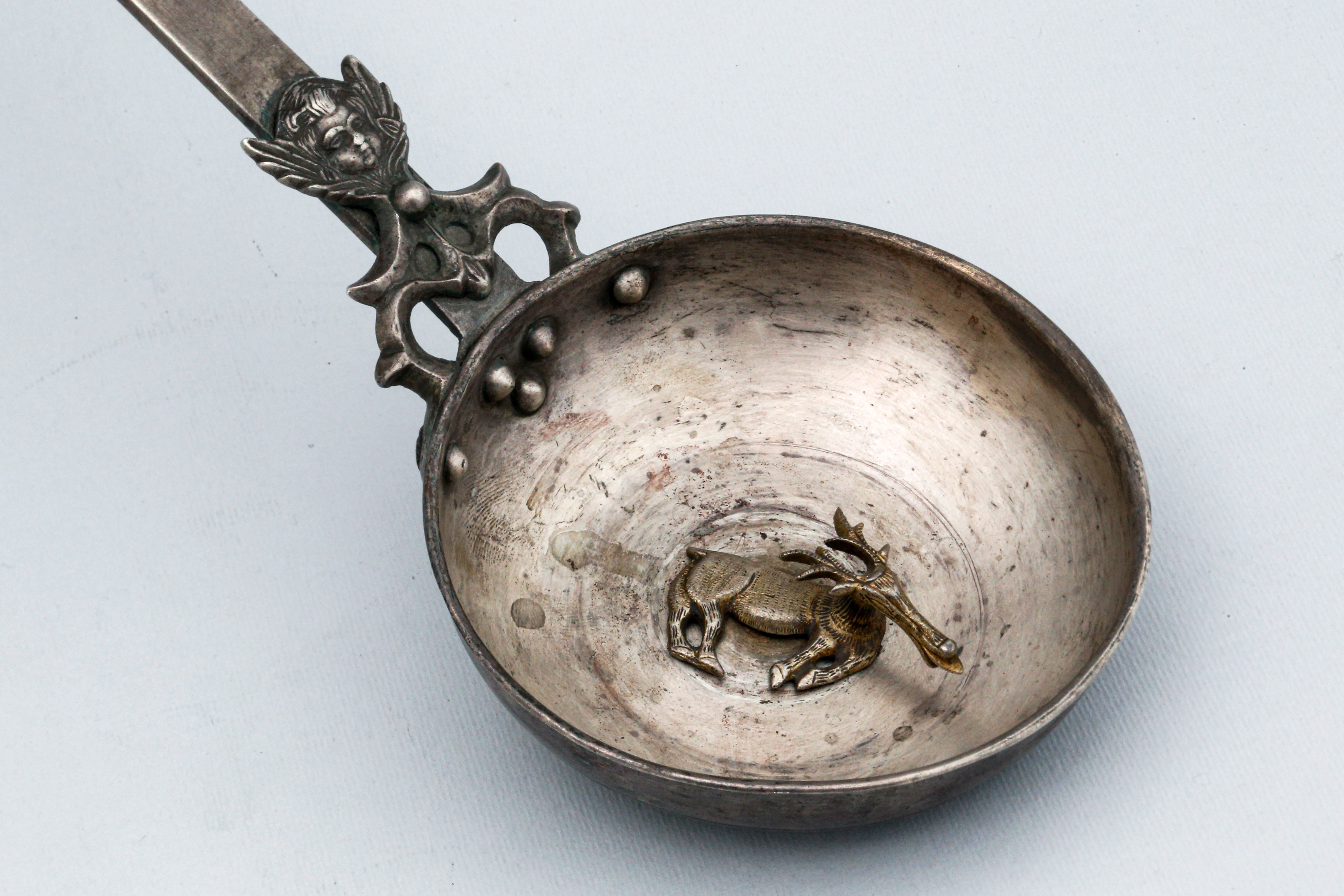
A small number of azarpeshas are also adorned with precious stones. Of particular note is a miniature figure of a deer attached to the base of the bowl of the azarpesha, whose head is articulated and movable. The deer was regarded as a sacred animal both in the pre-Christian period and in later tradition.[6]
In the cultures of Eastern European and Balkan regions, vessels decorated with deer figures are also known (e.g., Serbian silver vessels of the sixteenth century).[7] In addition to the deer motif, azarpeshas occasionally feature dove figures, which likewise carry symbolic significance.[8]
Analogues of the Azarpesha in Other Cultures
Similar types of handled drinking vessels can be found in the cultures of various peoples around the world. These include the Roman trulla; the Greco-Roman patera used in religious rituals; the Viking kovsh, which also spread into Slavic culture; the Scottish double-handled quaich, traditionally used in rituals of bonding and fraternity; and the Japanese hishaku — a ladle with a bamboo (and sometimes metal) handle, used in the preparation and serving of tea during ceremonial practices.
In African cultures as well, ladles made from the shells of bitter gourds with attached handles are attested. Despite these parallels and similarities, the traditional Georgian drinking vessel, the azarpesha, stands apart from the above examples both in form and in cultural meaning.
Historical Sources
In descriptions of Georgian life, foreign travellers frequently mention the azarpesha in the context of Georgian feasts and festive gatherings.
For example, the well-known French traveller Jean Chardin visited Georgia in the early 1670s and left numerous valuable accounts.[9] As a jeweller by profession, he naturally paid particular attention to precious objects, including drinking vessels such as the azarpesha:
„The tableware and furnishings were most remarkable. On the table there were about one hundred wine vessels: badias, bowls, q’antsis (horns), kulas, twelve azarpeshas, and others. The azarpeshas were almost all made of silver…“[10]
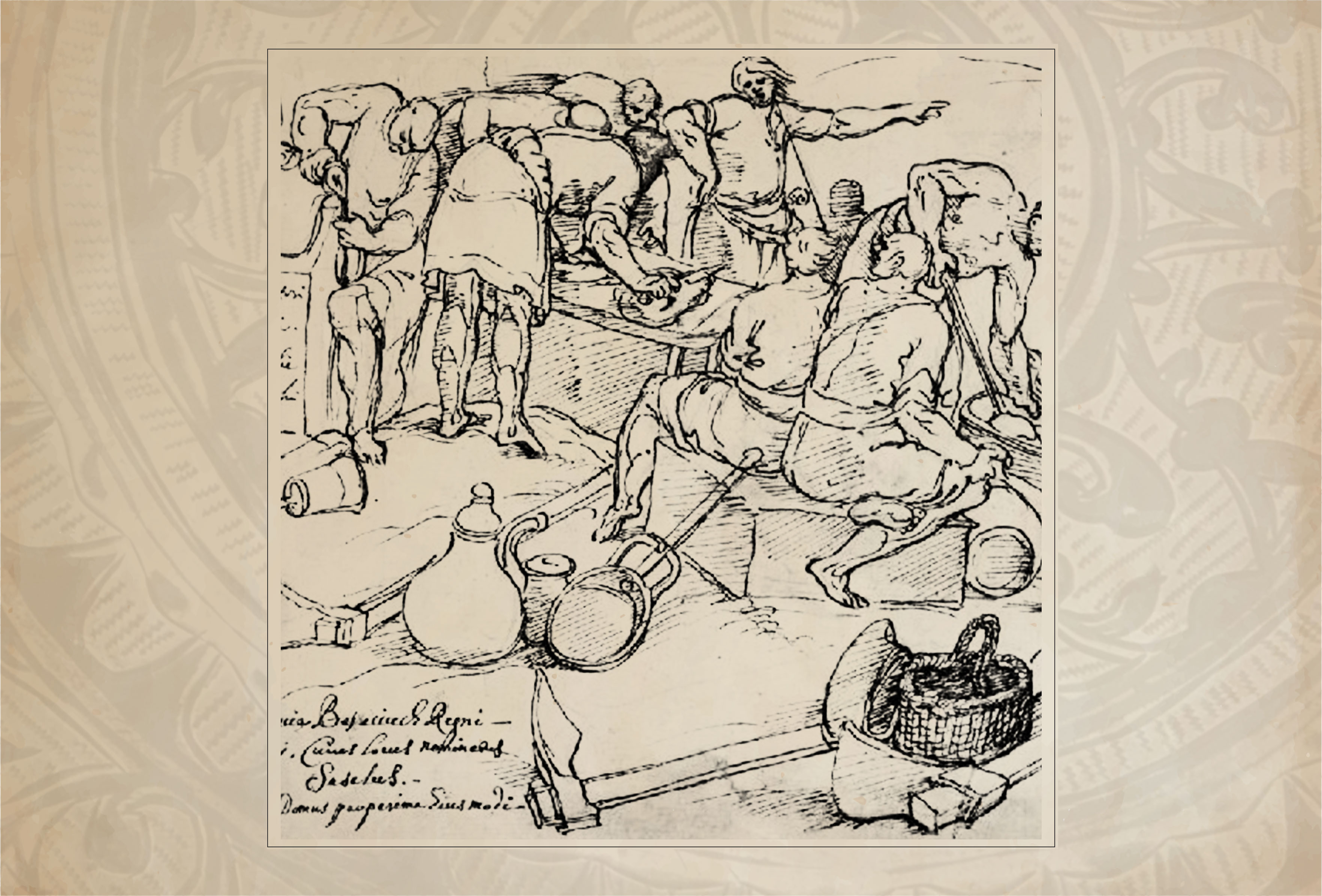
Earlier, in the 1650s, the Italian missionary Don Cristoforo de Castelli depicted scenes of Georgian feasting in his unique album, in which the culture of communal banqueting and tableware is vividly represented.[11]
Table Culture and the Functional Context of the Azarpesha
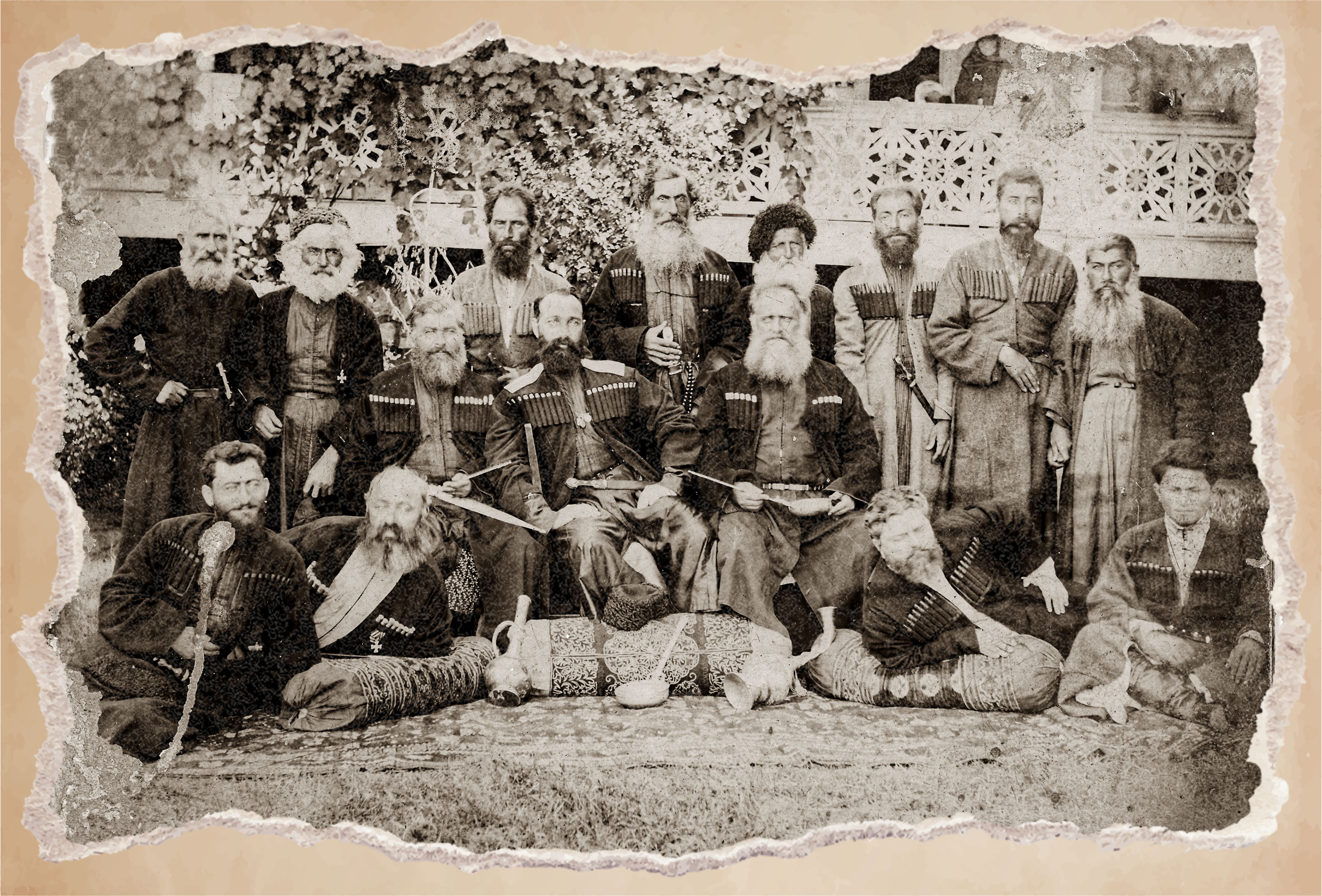
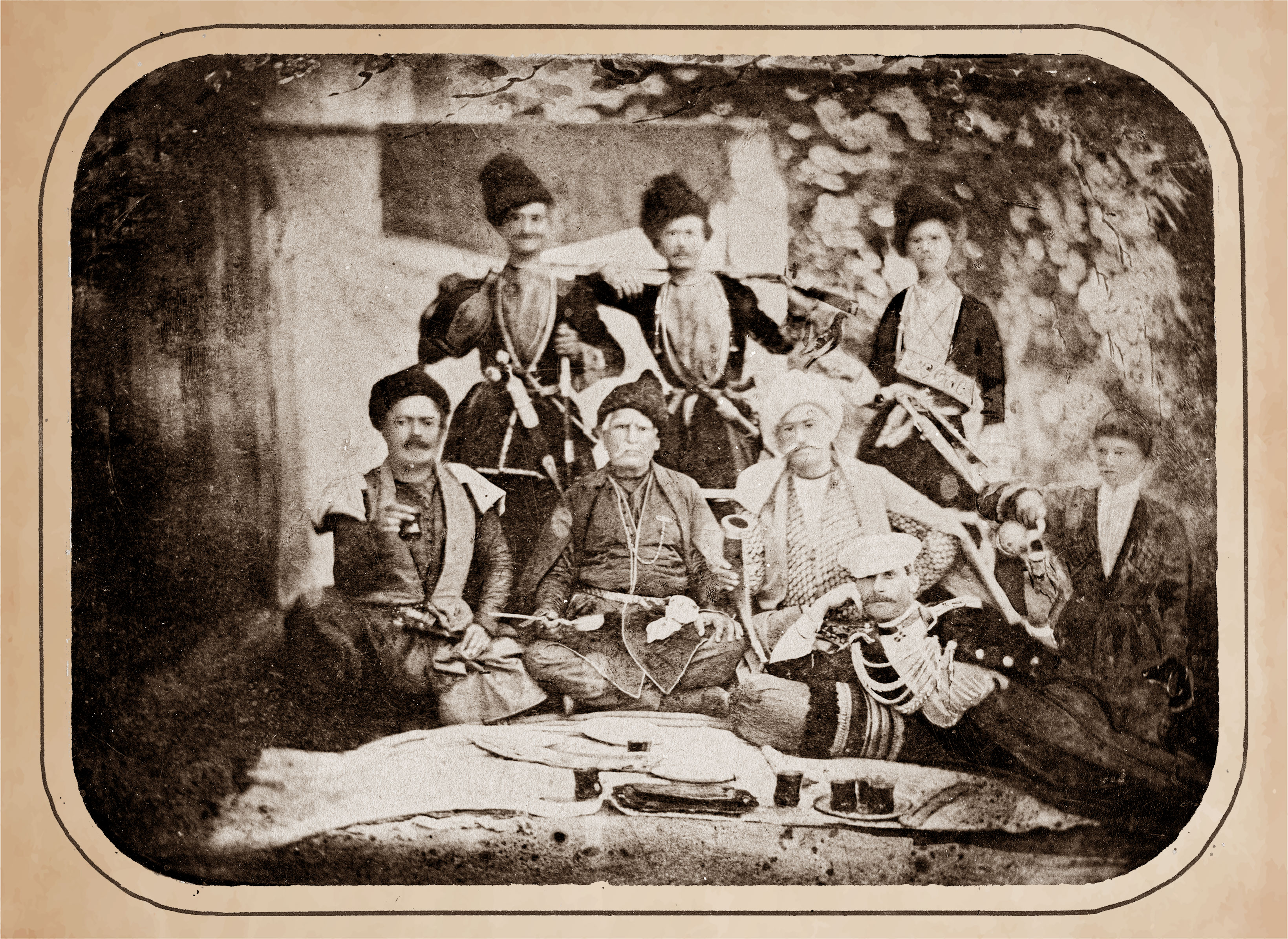
The traditions of the supra and festive banqueting, together with the institution of the tamada and the custom of the toast, constitute an integral and living element of Georgian cultural life. Despite the course of historical change, hospitality and communal feasting have remained among the most enduring social and cultural practices in Georgia.
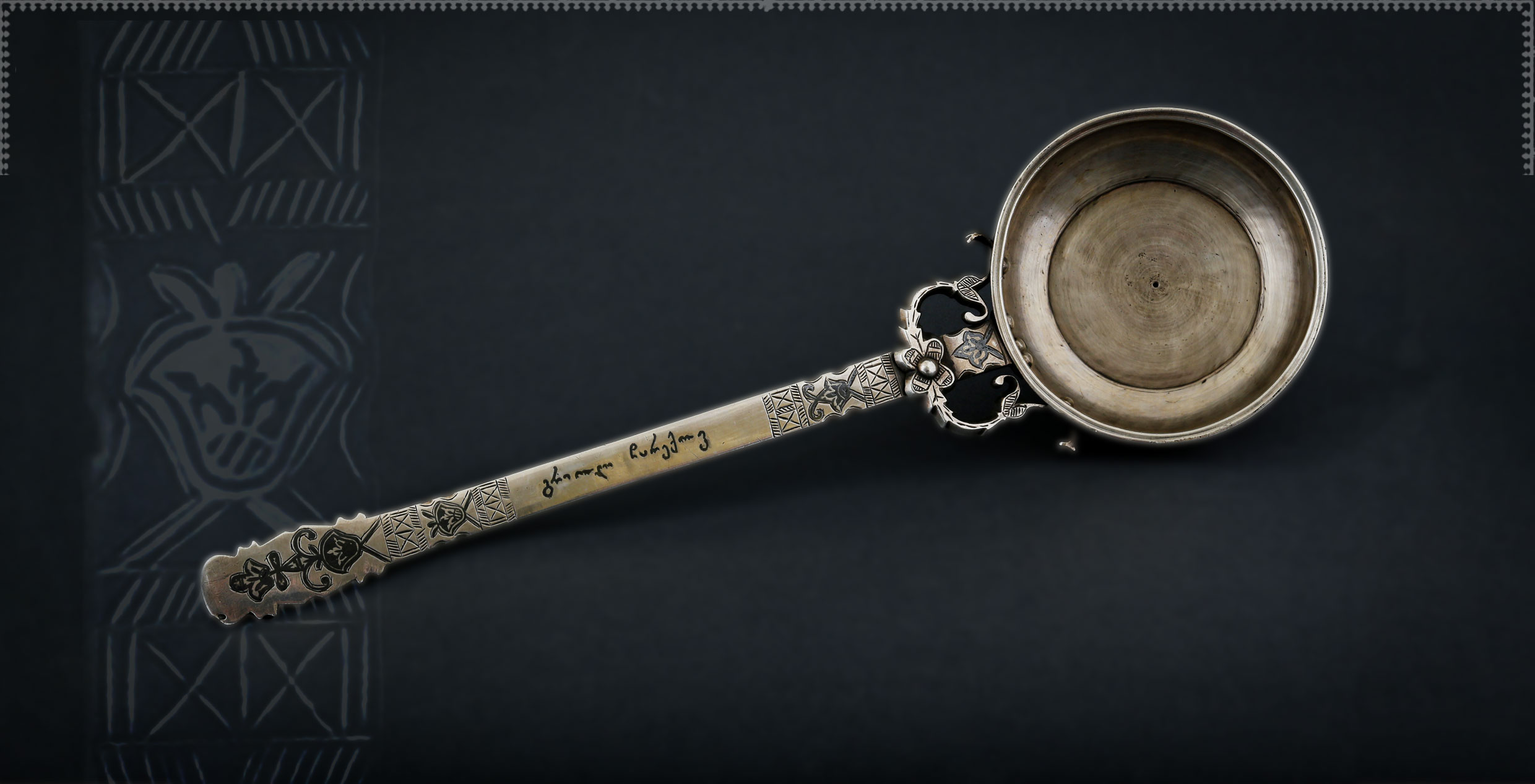
It is within this cultural setting that the functional and symbolic significance of the azarpesha is most apparent, for it has never entirely lost its original purpose. The vessel is not merely a drinking cup but also an instrument of social interaction. One expression of this is the custom of engraving on its handle not only the name of its owner but also verses and shairi (a short, witty, and humorous rhyming verse or impromptu epigram).
Inscriptions on the Azarpesha: Literary and Epigraphic Tradition
Various types of inscriptions are found on the handle of the azarpesha, including quotations from literary works, folk texts, and personal inscriptions. Together, these broaden the vessel’s cultural significance beyond its practical function.
Literary, Folk, and Epigraphic Texts
- Literary Sources
Among the inscriptions found on azarpeshas are quotations from The Knight in the Panther’s Skin, including:
„A welcome guest should have a cheerful host…“[12]
„The evil is overcome by Good, for Its essence is infinite…“[13]
- Folk Tradition:
Folk poems and toasts preserve a rich tradition of formulaic expressions associated with the supra. These texts are characteristically improvised and exist in numerous variants.
Expressions connected with the supra convey the joy of receiving guests and wishes for the prosperity of the household:
„O house, built for feasting, worn by rejoicing…“
„The guest will come and go, but prosperity will remain in the house…“
„A cheerful host is blessed with beloved guests…“
Texts in the form of toasts are also encountered:
,,Glory be to God, let me drink one more.
May God grant victory and well-being to all, to both guest and host.“
At times, even an attribute of the supra, such as the azarpesha, is personified and given a voice:
„I am the azarpesha of wine, the one that warms the mind,
Let me bring joy at the feast — do not pour me poor wine…“
„I am the silver azarpesha, made for drinking red wine,
For the delight of guests and of the host Murzaqan…“
These formulaic verses reveal the poetic vitality of Georgian table culture, in which objects, words, and ritual are perceived as parts of a single symbolic universe.
- Epigraphic and Personal Inscriptions
Personal inscriptions are also frequently found on azarpeshas. For example:
„I am the azarpesha of Kola Eristavi“[14]
„Levan Dadiani“[15]
„I belong to Givi Amilakhvari, son of Bardzim“[16]
This epigraphic material reflects the social and cultural significance of the azarpesha as an object signifying status.
The Azarpesha in Georgian Poetry
The azarpesha reached the height of its popularity during the first half of the nineteenth century. It is therefore unsurprising that the majority of surviving examples were produced during this period.
In Georgian poetry, the azarpesha appears as one of the symbolic images associated with the culture of the supra and festive conviviality. At times it is mentioned explicitly; at others, it forms part of the broader poetic imagery of the feast.
Nikoloz Baratashvili and Grigol Orbeliani portray the themes of the feast and wine as a space of fellowship and human emotion:
„Fill me with wine, and I’ll fill you with joy — drink, and rejoice!“ (from „On the Azarpesha“ by Nikoloz Baratashvili)
„Why curse your fate? Why grieve? What will despair gain you?
Drink — and the world will be yours.“ (Grigol Orbeliani)[17]
In these texts, the azarpesha is not always mentioned directly; nevertheless, the imagery of the supra and festive conviviality creates the cultural setting in which such drinking vessels naturally belonged.
Grigol Orbeliani explicitly refers to the azarpesha as a wine vessel used at the feast:
,,[May] the azarpesha, filled with Kakhetian wine, be in our hands.“ [18]
Akaki Tsereteli describes the dynamics of the supra as follows:
„The feast grew more animated as usual, and the passing of the drinking horn began!..
From hand to hand the cup-bowl of the azarpesha is moving!…
And those who do not drink much, from time to time are drinking from ‘kula’!…
There arose humming, chanting, and song with krimanchuli.“[19]
In this context, the azarpesha appears as a poetic symbol of the rhythm and movement of the feast.
This tendency continues in twentieth-century Georgian poetry as well.
Galaktion Tabidze:
„Bring quickly the precious bowl, the azarpesha!
O everything, filled with this gold!“[20]
Gogla Leonidze:
„A hundred guests were smiling at us like May.
In the hands of the tamada the azarpesha was filled ten times over,
In the tinkling sound of the tar I, your companion, whispered.“[21]
Lado Asatiani:
,,He raised the cup, and toasted the nobles’ feast,
And the azarpesha soared like a bird in flight.“[22]
Social Function and Historical Fate
It is noteworthy that the azarpesha was not an exclusively male drinking vessel. In many cases, the names of female owners are engraved on them, which indicates its role as part of domestic culture. It also formed a prestigious component of the bride’s dowry.[23]
In the twentieth century, in parallel with social and economic transformations during the Soviet occupation period, many azarpeshas were destroyed. During the Second World War, azarpeshas also appear in lists of valuables donated by the population. In the economic crisis of the 1990s, a considerable number of them were sold abroad.
Beyond its festive, symbolic, and poetic significance, the azarpesha is distinguished by another important feature — its modest capacity. A standard azarpesha holds approximately 50–60 millilitres, which reflects cultural norms of wine consumption and the value of moderation.
Interest in the azarpesha has increased in recent decades, and, like many other historical artefacts in Georgia, it is returning to contemporary life. Goldsmiths have also begun to explore the production of new versions of the vessel, which points to a broader trend of cultural revival and the renewal of tradition.
Sources:
[1] McGovern, Patrick E., Jalabadze Mindia, Stephen Batiuk, Michael P. Callahan, Karen E. Smith, Gretchen R. Hall, Eliso Kvavadze, et al. 2017. “Early Neolithic Wine of Georgia in the South Caucasus.” Proceedings of the National Academy of Sciences 114 (48): E10309–E10318. https://doi.org/10.1073/pnas.1714728114
[2] Georgian National Museum. “Azarpesha (19th c.). Silver, niello.” Tbilisi History Museum Collection.
[3] Kvantidze, Gulnara. 2014. Ethnographic Images from 17th–18th Century Georgian History (A Historical-Ethnographic Study). PhD dissertation, Ilia State University, Tbilisi.
[4] Visual Anthropology Archive (Ilia State University). “Azarpesha.”
https://visualanthropology.iliauni.edu.ge/ethno/index.php/azarpesha
[5] An alloy containing silver that is not classified as a precious metal.
[6] National Library of Georgia. Wikidict. “Deer.” See also: “The Mythologeme of the Deer and Myth-Making in Vazha-Pshavela’s Prose.” Spekali, no. 17 (2017). https://doi.org/10.55804/jtsuSPEKALI-17-7.1
[7] Serbian Orthodox Church Museum. Gilded Silver Cup with Deer Figurine. 16th century. Belgrade.
[8] “Azarpesha.” Georgian Encyclopedia. https://georgianencyclopedia.ge/ka/form/20019
[9] Chardin, Jean. 1711. Voyages de Monsieur le Chevalier Chardin en Perse et autres lieux de l’Orient. 10 vols. Amsterdam.
[10] Chardin, Jean. 1935. Travels in Georgia. Translated by Vasil Barnov. Tbilisi: State Publishing House. pp. 104–105.
[11] Castelli, Don Cristoforo de. 1976. Notes and Album on Georgia (1628–1654). Tbilisi: Metsniereba.
[12] Rustaveli, Shota. n.d. The Knight in the Panther’s Skin. Electronic edition. National Parliamentary Library of Georgia. http://www.nplg.gov.ge/ebooks/authors/shota_rustaveli/vefxistyaosani.pdf (accessed: 4 May 2026).
[13] Ibid.
[14] “Speaking Vessels.” n.d. Vinoge.com. https://vinoge.com/istoria/metyveli-sasmisebi (accessed: 4 May 2026).
[15] Ibid.
[16] Ibid.
[17] Kakaladze, Eter, and Nino Beridze, eds. n.d. “Azarpesha.” School Literary Dictionary-Reference. National Parliamentary Library of Georgia. http://www.nplg.gov.ge/saskolo/index.php?a=term&d=54&t=10857 (accessed: 4 May 2026).
[18] This Spring Has Also Come: Poetry. Book 10 (Series: School Library). 2007. Tbilisi: Bakmi Publishing. p. 74.
[19] Tsereteli, Akaki. n.d. Poetry. Collection 1. Ilia State University Library. https://library.iliauni.edu.ge/wp-content/uploads/2017/04/64-akaki-tseretheli-krebuli-poezia-1.pdf (accessed: 4 May 2026).
[20] Tabidze, Galaktion. n.d. “Gold.” poetry.ge. https://poetry.ge/poets/galaktion-tabidze/poems/3925.oqro.htm (accessed: 4 May 2026).
[21] Leonidze, Giorgi. n.d. “Taisi.” poetry.ge. https://poetry.ge/poets/giorgi-leonidze/poems/2163.taisi.htm (accessed: 4 May 2026).
[22] Asatiani, Lado. n.d. “Gulbaat Chavchavadze.” poetry.ge. https://poetry.ge/poets/lado-asatiani/poems/zoezo-gulbaat-chavchavadze (accessed: 4 May 2026).
[23] Luarsab Togonidze, personal collection (azarpesha with a woman’s name inscription), unpublished material.


.jpg)