Georgian Ceramics: A Continuous Form of Culture

Introduction
Ceramics is one of humanity’s oldest creative and technological discoveries. It is the result of human interaction with the natural elements — earth, water, air, and fire. The fusion of these four forces produced a material that enabled people not only to create essential objects for everyday use, but also to communicate their culture, beliefs, and identity.
Clay can be regarded as a kind of living archive, preserving the history of human existence. Some of the earliest archaeological finds — Neolithic vessels, small figurines, or architectural fragments — are made of clay. They tell the stories of people who cooked food, built homes, raised children, and shaped the world we inhabit today. The history, traditions, and character of entire eras are imprinted on its surface.
In this sense, ceramics is not merely a craft or a technology, but a continuous line of knowledge transmission. Clay-working techniques, decorative markings, and the forms themselves have evolved over centuries into a collective memory through which human history still speaks.
The History of Georgian Ceramics
Georgian ceramics has an ancient tradition and a long history. Working with clay as a form of material culture in Georgia dates back to the early Neolithic period (6th–5th millennium BC). Archaeological finds from this era clearly show that the South Caucasus is one of the earliest centres of ceramic culture in Eurasia. The vessels of that time were hand-made from relatively coarse clay and fired at low temperatures, as indicated by their pinkish or grey coloration. Neolithic ceramics generally feature simple forms and are often decorated with geometric patterns.
In the Chalcolithic and Early Bronze Age (4th–3rd millennia BCE), new artistic features emerged.
The forms became more refined, surfaces were treated and burnished, and black and reddish tonalities appeared, sometimes accompanied by linear ornamentation or reliefs. Overall, the shapes became more sophisticated and diverse.
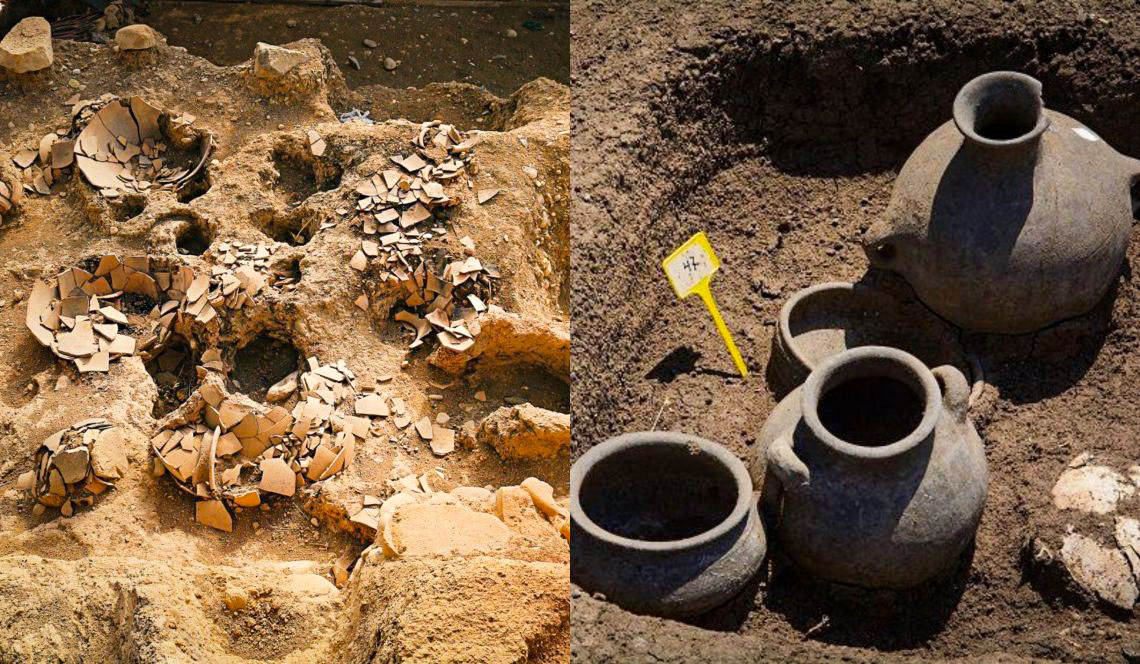
Middle Bronze Age pottery and a tomb discovered in Kvemo Nikozi. (Source: 1tv.ge)
Later, in the Middle Bronze Age (2nd millennium BCE), ceramics acquired a wider range of functions. Vessels were used not only for household purposes, but also for ritual and funerary contexts. Polished, black-smoked ceramics and narrative painted decoration also appear during this period.
Significant changes and developments are evident in the ceramics of the Classical period (second half of the 1st millennium BCE – 1st century CE). It is precisely at this time that the potter’s wheel — the so-called morgvi[1] — appears on the territory of Georgia, fundamentally transforming the production process.
Objects from this period are distinguished by the simplicity of their forms, the even thickness of their walls, and higher-quality firing. Classical ceramics were mostly fired to a reddish tone and are characterised by plain, large forms. They were generally covered entirely with slip (ts’ernaki[2]), although some finely painted pieces also occur, showing scenes of battle or hunting.
The introduction of the wheel made serial production possible. It is upon this continuous tradition that Medieval Georgian ceramics (9th–15th centuries) developed. During this era, Georgian ceramics reached both technological and aesthetic maturity. Glazed ceramics became widespread, featuring green, blue, and brown tonalities, and were primarily produced in urban workshops. Glazed tiles were used both in architectural decoration (church floors, walls, domes) and for household vessels.
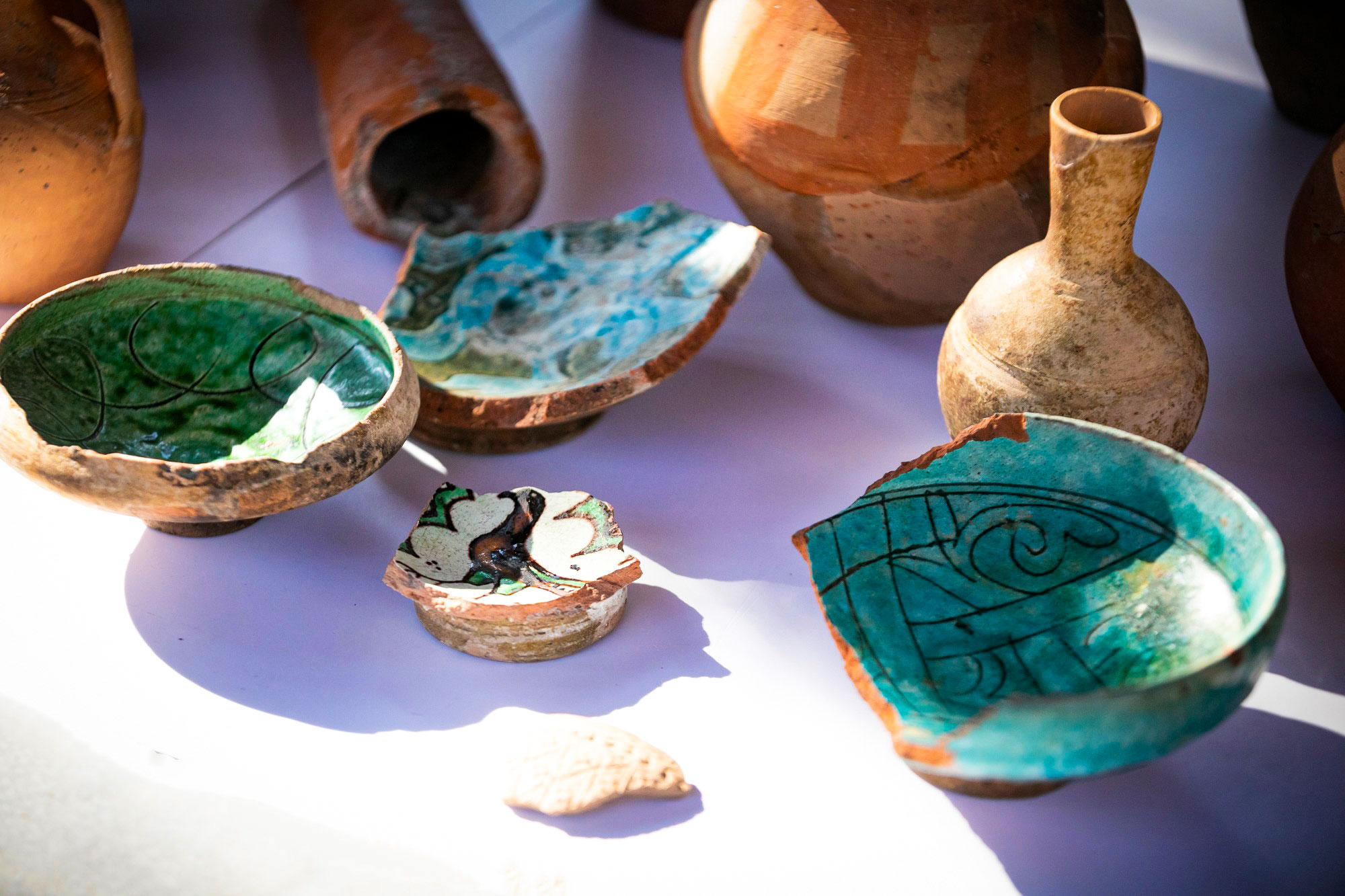
A domed cellar revealed at 3/7 Akhospireli Street (17th–18th c.) and a glazed bowl discovered in the adjacent cellar (11th–12th c.). Source: Official Facebook page of the Tbilisi Development Fund.
Local workshops operated in various regions and cities of Georgia, including Tbilisi, Telavi, Dmanisi, Gori, and Kutaisi, each with its own technical and decorative traditions. Despite the high level of craftsmanship and creative diversity, working with clay and making pottery has always been an integral part of everyday life. Pottery — which required technical knowledge, skill, experience, and the ability to work in harmony with the natural environment — was one of the main occupations in Georgian rural communities.
Potters or ceramists personally extracted clay, processed it on site, assessed the quality of the material, and created vessels that precisely met local needs and tastes. This folk knowledge was passed down from generation to generation orally, through practical training, without any written instructions.
From the 19th century onward, ceramic production gradually began to acquire an industrial character, although folk workshops continued to operate in nearly every region.
Regional Traditions and Workshops of Georgian Ceramics
The diversity of Georgian ceramics has always been closely linked to the country’s geography, natural resources, ways of life, and cultural plurality. The tradition of pottery — and specifically of clay-working — developed distinct stylistic features and forms in different parts of Georgia.
Each region had its own type and color of clay, as well as traditional methods of processing it, which in turn shaped the forms and functions of the vessels.
In eastern Georgia — Kakheti, Shida Kartli, and Kvemo Kartli — light, thin-walled vessels were widespread. Local clay typically contains higher levels of aluminum silicates and less iron oxide, resulting in lighter-colored products often marked by warm reddish tones. Especially notable are the works of masters from Telavi, Ikalto, Dmanisi, and Gori, known for their symmetry and purity of form.
In western Georgia — Imereti and Guria — the clay is fattier and richer in iron compounds, producing vessels that fire to dark brown or almost black tones. Imeretian potters often created massive and durable household vessels — cooking pots, wine jugs, grain-storage containers, and water vessels. This region was characterised by a synthesis of practicality and aesthetics; decoration was rarely excessive, yet the shapes and proportions were refined and thoughtfully adapted to their function.
In both western and eastern Georgia, ceramic production was closely linked not only to daily life but also to ritual culture — many vessel forms (for example, sanctuary pots or long-necked jugs) were associated with churches and religious festivals.
In Svaneti and Racha, ceramic production was practiced on a smaller scale, shaped by the climatic conditions and scarcity of natural resources. Nevertheless, local masters worked there as well, producing small vessels and ritual objects, often made from coarse-textured clay rich in natural impurities.
Each region was distinguished by its particular forms, materials, and work methods. These traditions represent one of the most enduring forms of folk knowledge transmitted orally. Today, traces of this diverse heritage can still be seen in the works of contemporary Georgian ceramic artists.
Georgian ceramics continues its dialogue with its own past. In the 20th century, its development became closely linked to the country’s social and economic transformations. During the Soviet period, ceramics was assigned new roles, becoming part of both industrial production and ideological culture. Within the state-controlled system, an institutional model of art education was established: ceramic factories were built in Tbilisi and in the regions, where traditional craftsmanship was combined with standardised production. A department and workshops of artistic ceramics were founded at the Tbilisi State Academy of Arts. During this period, the concept of decorative-applied arts took shape, within which ceramics came to be regarded as one of the “state-significant” artistic fields.
Despite the strict boundaries of this system, ceramics remained a space where masters and artists sought to preserve their individual style. Interest in local materials, forms, and traditions persisted — though often only on an aesthetic level, since natural clays used in earlier periods were largely replaced with technologically processed materials for industrial production. As a result, ceramics became partly distanced from its historical roots — from the direct engagement with clay and the environmentally embedded practices that had shaped it for millennia.
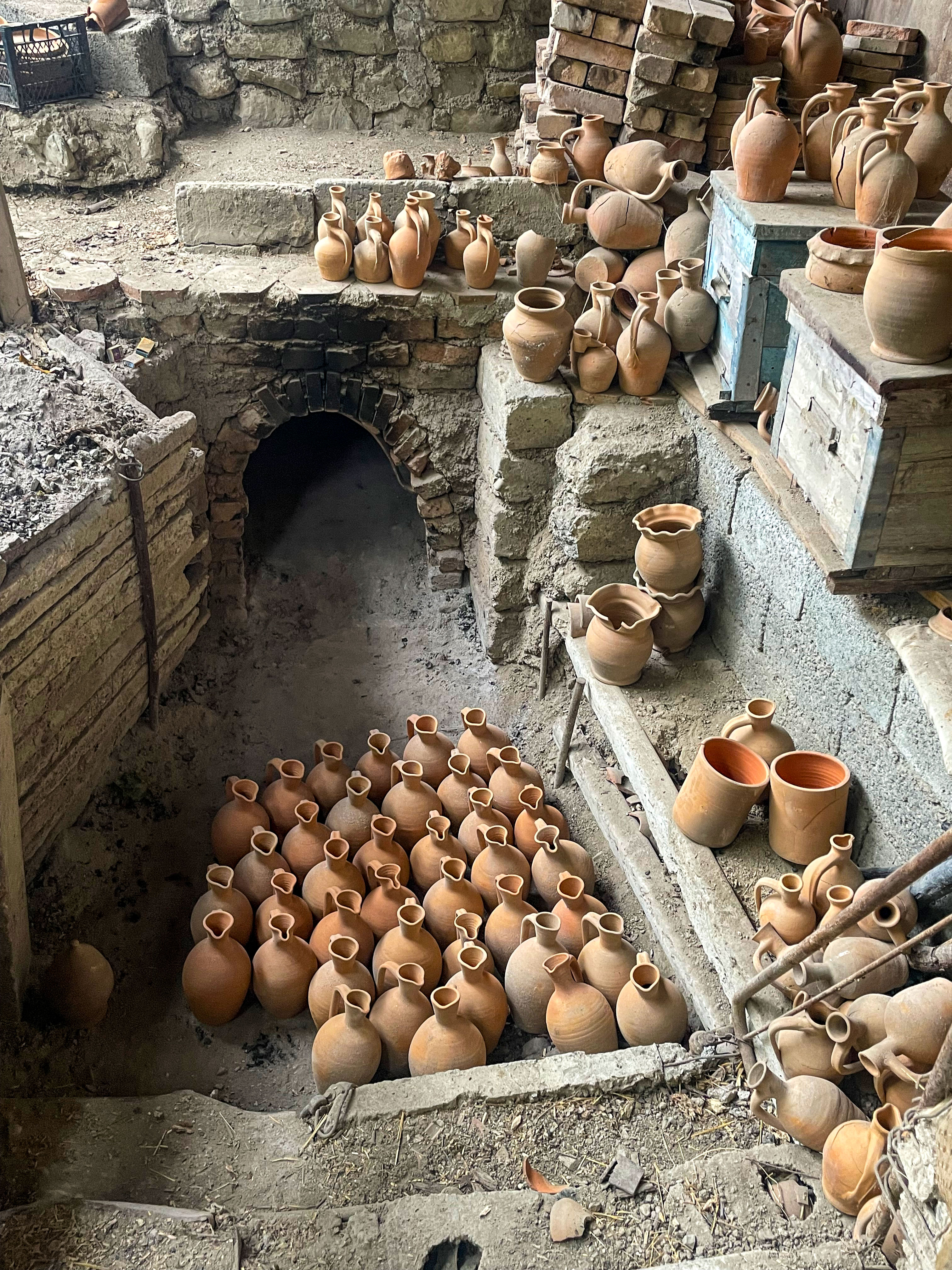
Atsquri, Kakheti. A traditional and particularly rare type of pottery kiln belonging to potter Ramaz Gakhutishvili (photo by Irine Jibuti).
The New Life of Contemporary Georgian Ceramics
After the collapse of the Soviet Union, the field of ceramics in Georgia entered a severe crisis. Factories shut down, state commissions disappeared, and the educational and scientific infrastructure collapsed. Ceramicists, masters, and craftsmen who had worked for decades within a unified system suddenly found themselves forced to continue their practice independently, with almost no material or technical support. Many abandoned the profession altogether, and the workshops where masters and apprentices had once worked side by side gradually vanished from the everyday life of cities and villages. During this period, ceramics in Georgia almost completely withdrew from both public and cultural space. It was no longer an industrial product, nor an active artistic field. Only a few masters and ceramic artists managed to preserve their practice individually, often under extremely limited conditions. This was a time when the ceramic tradition survived solely through dedication.
Despite this difficult background, in recent decades signs of development in a contemporary direction have gradually begun to emerge.
Today, contemporary Georgian ceramics is not a large-scale industry, but it is precisely within this non-institutional condition that it may be acquiring a particularly compelling modern relevance. Ceramics has become a personal practice — a space for research, experimentation, and self-expression. Despite economic challenges, shortages of raw materials, and the absence of a stable market, the field remains alive.
Since the late 2000s, a new generation of artists — including researchers, teachers, and regional workshops — has fostered a tendency that gradually reconnects ceramics with its true roots. The use of local clay remains limited, yet individual initiatives are increasingly exploring the material’s possibilities and working toward its revival in practice. New small workshops, artistic spaces, and independent projects continue to emerge. This is not an organised movement, but rather a free, self-directed process.
Contemporary Georgian ceramics is created with a renewed understanding, in which traditional forms and techniques merge with a new visual language. In this process, both functional objects (vessels, interior elements) and more artistically refined works are produced, emphasising aesthetics, expressiveness, and the individual signature of the maker.
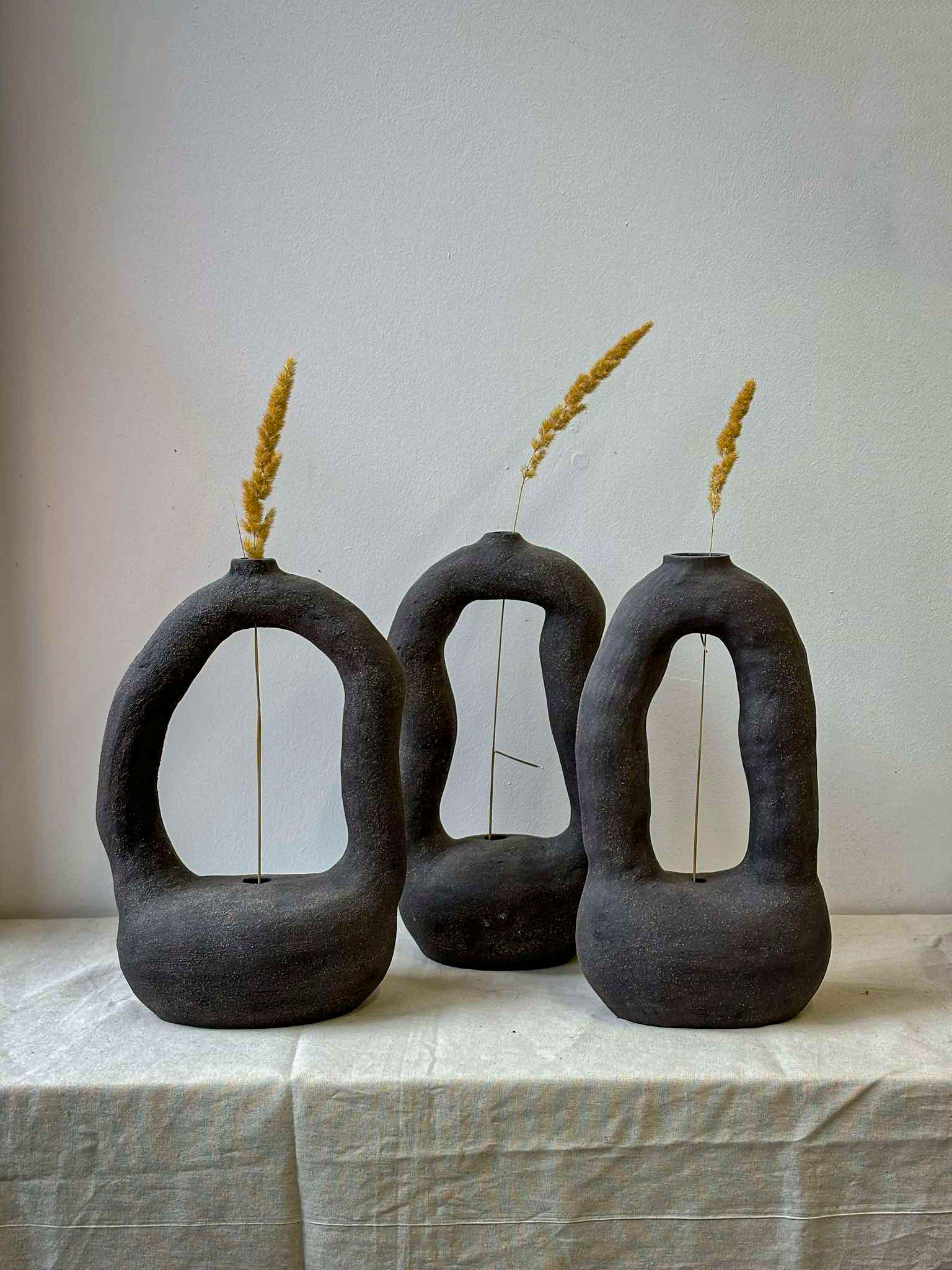
Stoneware ceramics. Photograph by Irine Jibuti. 2022.
Today, Georgian ceramics exists as a fragile yet vibrant space — less a stable institution than a symbol of inner resilience. It is precisely within this quiet sphere, shaped by individual workshops and ongoing research, that one can sense the breath of an ancient tradition, preserved for centuries in the clay held in human hands.
Biblipgraphy:
- Khakhutaishvili, Davit. 1970. Uplistsikhe: Arkeologiuri kvleva-dziebis shedegebi, vol. 2. Edited by Shalva Amiranashvili. Tbilisi: Metsniereba.
- ortkipanidze, David, ed. 2013. Keramikuli naketobani: Shua-saukuneebis Sakartveloshi [Ceramics in Medieval Georgia]. Tbilisi: Bakur Sulakauri Publishing.
- Javakhishvili, Ivane, ed. 1979. Masalebi Sakartvelos shinamretsvelobis da ts’vrili khelosnobis istoriisatvis: 5 tomad. Mech’vrch’ Tomi II, nawili I [Materials for the History of Georgian Home Industry and Small Crafts: In Five Volumes. Weaving. Volume II, Part I]. Tbilisi: Metsniereba.
[1] Tool for making clay vessels.
[2] A type of mineral earth used for decorating pottery